
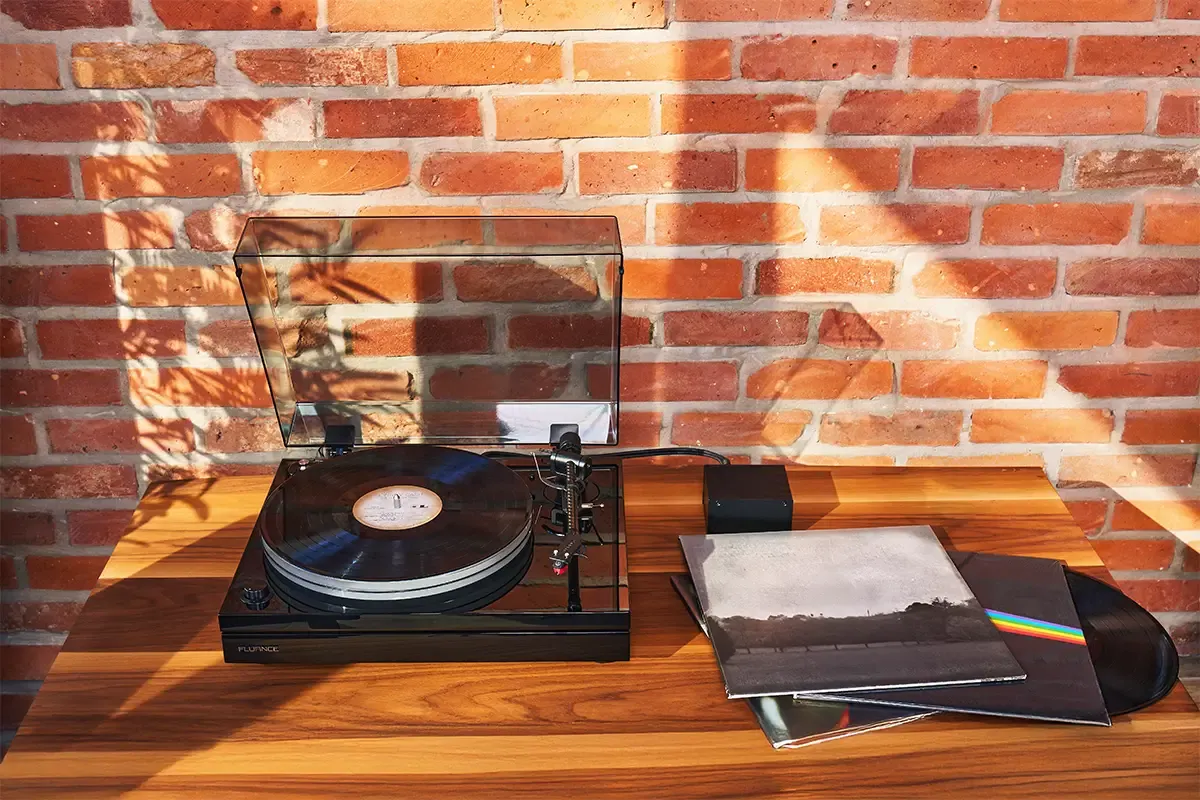
There is an unfair beauty in the way a soft, ordinary little creature can disappear into itself and somehow come back lighter, brighter, and built for a world it could not reach before. Wings where there used to be weight. Color where there used to be camouflage. This quiet little act of nature that feels so delicate and impossible you almost have to stop and appreciate it.
A scene so beautiful that even for a turntable brand, you pause for a second. And yes, that sounds dramatic, but with the Fluance RT87, it is not really that much of a stretch.
For years, Fluance has been easy to understand. You bought one because you wanted a lot of turntable for the money. Not the fanciest name, not the most old-school audiophile flex, just a really solid deck with good parts, fair pricing, and enough performance to make the usual entry-level stuff feel a little silly.
But the RT87 feels like Fluance stepping into something new. It still has that same value-first DNA, but the whole thing feels like it wants to compete with a different class now. Their new turntable is not just a set of tiny spec-sheet tweaks on the 85. They are the kind of changes that make it feel like Fluance is trying to become a more serious kind of turntable brand.
So this review is not just about whether the RT87 is better than the RT85. It is about whether Fluance can move up a tier without losing the thing that made people like Fluance in the first place.
Table of Contents
In this guide, we’ll cover everything you need to know about the Fluance RT87, broken down into the following sections:
- What Fluance Is Really Doing Here
- Build & Features of the Fluance RT87
- Comparing to Other High-End Turntables
- Conclusion: Is It Worth It?
Affiliate Disclosure: We’re a small team of vinyl enthusiasts – if you get value from our insights, using our affiliate links (including Amazon Associates) helps us earn a commission and keep the lights on at no extra cost to you. Thank you for supporting Recordbuilds.com!
What Fluance Is Really Doing Here
So yes, as you can probably tell, this is going to be something a little different.
It would feel wrong to treat the Fluance RT87 like a regular product review, because honestly, it is more exciting than that. This is not just another turntable where we list the specs, compare the price, and decide whether the thing is “worth it.” Fluance has had a pretty clear identity for years, and the RT87 feels like one of those moments where the identity starts to shift.
The RT87 is not simply an upgrade over the RT85 in the obvious way. That would be too easy. The RT85 is still the sweet spot for a lot of people, and probably still the safer recommendation if someone wants the best Fluance turntable before the price starts getting uncomfortable. But the RT87 is doing something stranger than just giving you a better version of the same old formula.
That is why the whole butterfly thing is not actually as ridiculous as it sounds.
You still get the Fluance value logic underneath it, but the shape of the turntable has changed. The dual-plinth design is the biggest signal, because instead of using the same Reference platform and simply swapping cartridges around, Fluance is separating the motor and tonearm across two layers. Then you add the carbon fiber tonearm with VTA adjustment, the thicker acrylic platter, the extra mass, and the higher-end cartridge options, and suddenly this starts feeling less like “the new top Fluance” and more like Fluance trying to walk into a different room.
And that changes the question.
You are no longer just asking whether Fluance gives you good parts for the price. You are asking how far that formula can stretch before Fluance stops feeling like the smart-value option and starts feeling like something more serious.
But at the end of the day, it is still a turntable. A high-end turntable, sure, but still a turntable, so here at Recordbuilds we just want to set the ground rules before we go any further.
If you are already looking at something like the RT87, you are probably not trying to build the easiest possible vinyl setup. You are probably building a more intentional system around a phono preamp, an amp or receiver, and a proper pair of speakers: quick diagram for reference below:

If that’s a bit confusing, we have a ton of example high-end, audiophile-esque setups on our community builds – good go-to spot for getting setup ideas.
Build & Features of the Fluance RT87
Alright, so enough of the butterfly stuff for a second. At the end of the day, the RT87 is still a turntable, and if Fluance is going to ask for more money than the RT85, the actual hardware has to justify it.
On paper, the RT87 is not Fluance just taking the RT85, tossing in a new cartridge, and calling it the new flagship. The whole shape of the table changes here: dual-plinth body, carbon fiber tonearm, VTA adjustment, thicker acrylic platter, 78 RPM support, hanging weight anti-skate, and two higher-end cartridge options depending on how you want to build the setup.
Here is the quick spec table first, then we will get into the parts that actually matter.
| Price | $799.99 |
|---|---|
| Preamp | Not included (external required) |
| Cartridge | Audio-Technica AT-VM95ML or Ortofon 2M Blue Moving Magnet |
| Platter | High-mass acrylic, 22 mm |
| Stylus | Microlinear diamond (AT-VM95ML) or nude elliptical diamond (2M Blue) |
| Plinth | Dual-plinth MDF design with motor and tonearm isolation |
| Drive System | Belt drive with servo speed control motor |
| Auto Stop | Yes |
| Tonearm Type | Straight 9-inch carbon fiber tonearm with VTA adjustment |
| Tonearm Material | Carbon fiber |
| Counterweight | Yes, adjustable |
| Speeds | 33 1/3, 45, and 78 RPM |
| Anti-Skate | Hanging weight anti-skate system |
| Wow and Flutter | 0.06% |
| Weight | 21 lb |
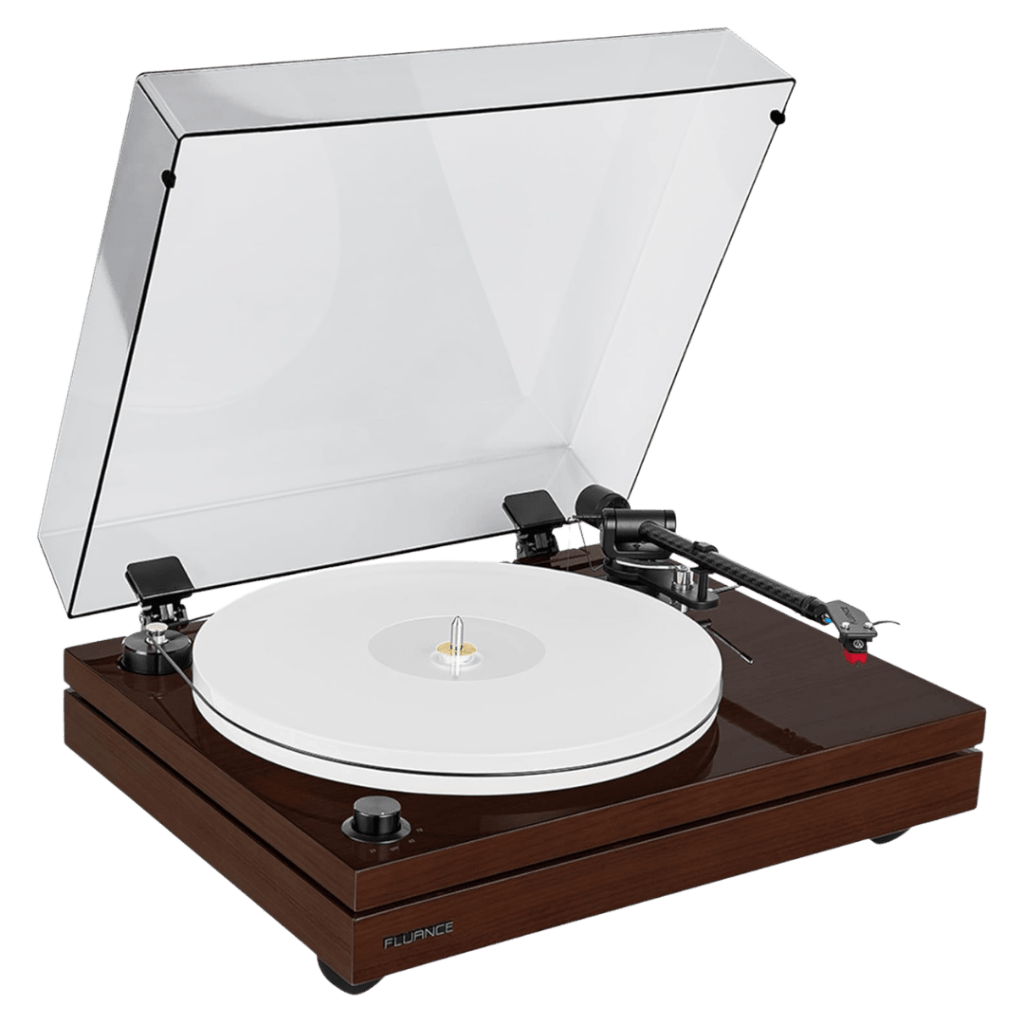
TThe biggest change is the dual-plinth design. Instead of putting everything on one main base like the RT85, the RT87 separates the motor and tonearm across two layers. That sounds technical, but the idea is pretty simple: keep motor vibration away from the stylus as much as possible.
Awesome decision to go after the structure of the table itself.
The platter is another real upgrade. The RT85 already has acrylic, so this is not some totally new Fluance feature, but the RT87 gets a thicker 22 mm acrylic platter with more mass.
Then there is the tonearm. The RT85 uses an S-shaped aluminum arm, which is perfectly solid. The RT87 moves to a straight carbon fiber arm with VTA adjustment, which gives you a little more room to fine-tune things if you ever get deeper into cartridge setup. Not everyone will use that, but it is nice to have on a table at this level.
The cartridge choice is where I think it gets more interesting. You can get the RT87 with the Ortofon 2M Blue, which keeps it close to the RT85 vibe, or you can get it with the Audio-Technica AT-VM95ML. That second one is probably the version I would pay more attention to, because the microlinear stylus makes the RT87 feel like more of a real step forward instead of just a fancier Fluance.
The hanging anti-skate weight is also worth knowing about. It is a little more hands-on than a simple dial, so this is not necessarily the easiest Fluance table to set up. But that is kind of the point. The RT87 assumes you are willing to care a little more.
Same thing with the lack of built-in preamp or Bluetooth. That is not Fluance forgetting features. That is Fluance telling you what kind of table this is supposed to be. You are meant to run it into a phono preamp or receiver, then into proper speakers.
So no, the RT87 is not the simple plug-and-play pick.
It is the Fluance you look at when the RT85 still makes sense, but you want to know what happens when Fluance pushes the whole table a level higher.
Comparison to Other High-End Turntables
For the RT87, the comparison gets a little more interesting because Fluance is clearly trying to play in a different lane here.
Of course, it makes sense to compare it to the RT85 first. That is the obvious one. Same brand, same general family, and probably the table most people are wondering about if they are already looking at Fluance.
But with the RT87, it would be a little too easy to stop there.
This thing is venturing into more serious territory, so we pulled in a few more left-field options too. Not random beginner tables, but real audiophile-grade stuff with different design choices, stronger brand names, and specs that make the RT87 actually prove itself.
So yes, we’ll look at the top Fluance comparison first, but we are also going to see how the RT87 holds up once the room gets a little more serious.
The Previous Fluance Flagship
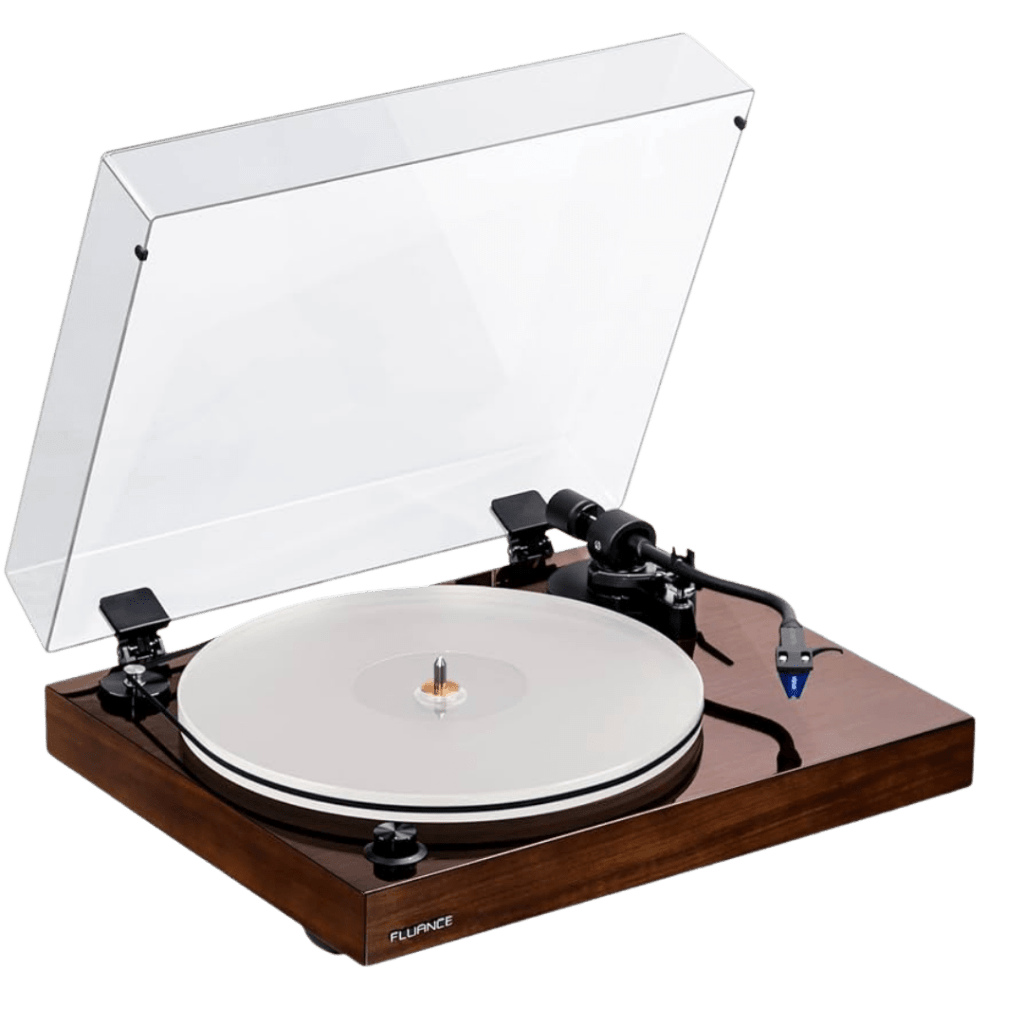
Fluance RT85
The RT85 is the obvious place to start because, for a long time, this was the Fluance turntable people pointed to when someone wanted the “just buy the best one” answer.
And honestly, it still makes a lot of sense.
You get the acrylic platter, the Ortofon 2M Blue, auto stop, adjustable counterweight, anti-skate, and the classic Fluance Reference setup for a lot less money than the RT87. For many people, that is still going to be enough turntable.
So the RT85 is still the safer sweet spot. The RT87 is the version for someone who looks at the sweet spot and immediately wonders what happens one step after that.
| Feature | Fluance RT85 | Fluance RT87 |
|---|---|---|
| Price | $550 on Amazon | $799.99 |
| Turntable Type | Manual, Belt-Drive with Auto Stop | Manual, Belt-Drive with Auto Stop |
| Plinth Material | MDF with Real Wood Veneer | Dual-Plinth MDF Design |
| Platter | Acrylic (High-Mass) | 22 mm High-Mass Acrylic |
| Tonearm | S-shaped aluminum tonearm; adjustable counterweight & anti-skate | Straight 9-inch carbon fiber tonearm with VTA adjustment |
| Cartridge | Ortofon 2M Blue (Nude Elliptical) | Audio-Technica AT-VM95ML or Ortofon 2M Blue |
| Speeds | 33 1/3 and 45 RPM | 33 1/3, 45, and 78 RPM |
| Preamp | No (external required) | No (external required) |
| Bluetooth | No | No |
A Cleaner Design

U-Turn Orbit Special
The Orbit Special is a good comparison because it has a super clear appeal. It is clean, simple, modern, and good-looking, while still being a proper manual turntable. It is the more design-forward option, and for a lot of people, that is going to matter.
The RT87 is just a heavier, more ambitious hardware package.
You have the dual-plinth design, which is obviously going to be one of the biggest differences in most of these comparisons.
So the Orbit Special is the one I would look at if I wanted something beautiful and simple. The RT87 is the one I would look at if I wanted the more serious spec sheet, and felt like the extra money should go into isolation, tonearm adjustability, platter mass, and cartridge performance.
| Feature | U-Turn Orbit Special | Fluance RT87 |
|---|---|---|
| Price | $549 on Amazon | $799.99 on Amazon |
| Turntable Type | Manual, Belt-Drive | Manual, Belt-Drive with Auto Stop |
| Plinth Material | MDF finish or solid hardwood options | Dual-plinth MDF design with motor and tonearm isolation |
| Platter | Grooved Acrylic | 22 mm High-Mass Acrylic |
| Tonearm | OA3 magnesium gimbal tonearm with adjustable counterweight | Straight 9-inch carbon fiber tonearm with VTA adjustment |
| Cartridge | Ortofon 2M Red | Audio-Technica AT-VM95ML or Ortofon 2M Blue |
| Speeds | 33 1/3 and 45 RPM with electronic speed control | 33 1/3, 45, and 78 RPM |
| Preamp | No (external required) – built-in-preamp version available | No (external required) |
| Bluetooth | No | No |
The Established Dual-Plinth Table
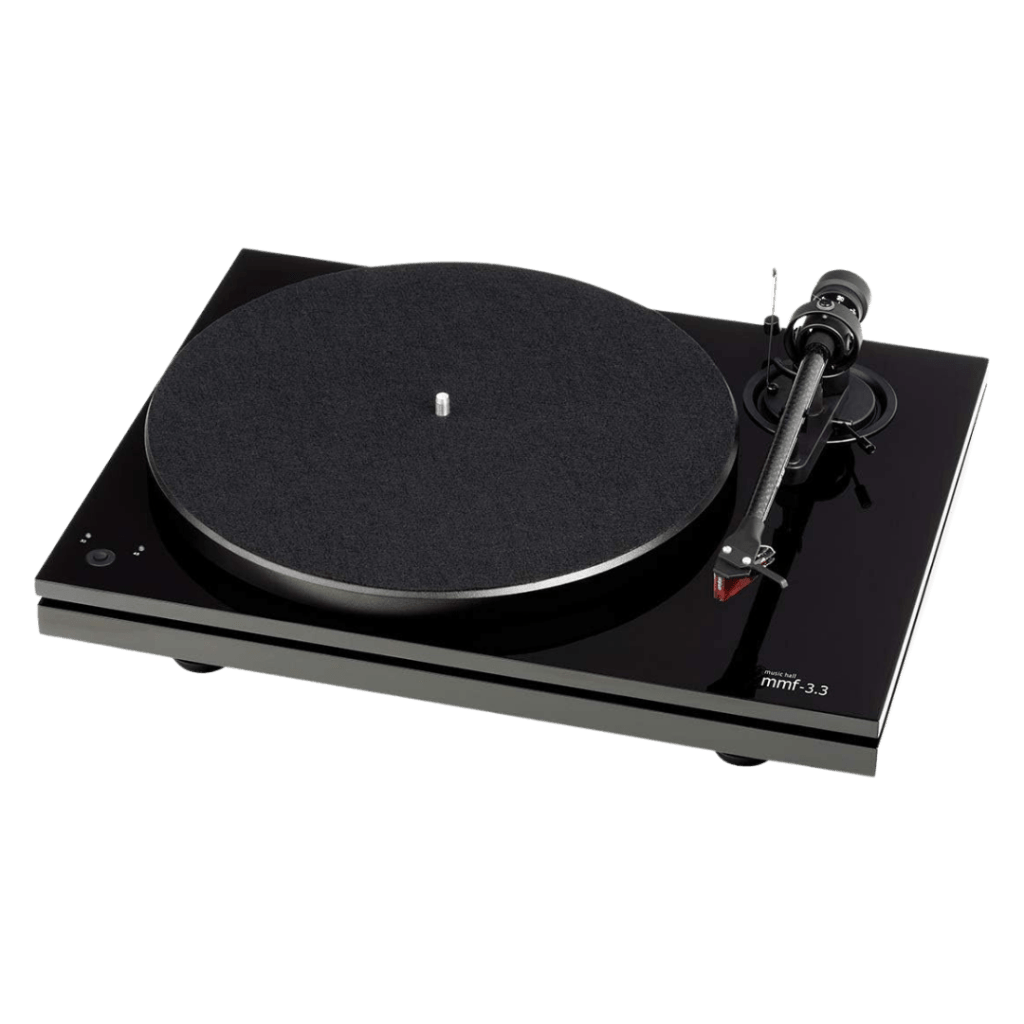
Music Hall MMF-3.3
The Music Hall MMF-3.3 is probably the fairest outside comparison because it is not just another turntable around the same price. It is another dual-plinth table.
The Music Hall has the more established audiophile name, the dual-plinth design, a carbon fiber tonearm, 33/45/78 RPM playback, and an Ortofon 2M Red cartridge. It feels like the more traditional version of this lane.
The RT87 is a little cheaper and arguably more loaded on paper. You get the thicker acrylic platter, auto stop, VTA adjustment, and the choice between the AT-VM95ML or Ortofon 2M Blue.
So this is probably the cleanest test of the RT87’s whole pitch. If you want the safer name in dual-plinth turntables, the Music Hall makes sense. If you want the newer Fluance version with more spec-sheet value for the money, the RT87 is the one making the case.
| Feature | Music Hall MMF-3.3 | Fluance RT87 |
|---|---|---|
| Price | $895 on Amazon | $799.99 on Amazon |
| Turntable Type | Manual, Belt-Drive | Manual, Belt-Drive with Auto Stop |
| Plinth Material | Dual-plinth design with motor and electronics isolation | Dual-plinth MDF design with motor and tonearm isolation |
| Platter | Full-size alloy platter with felt mat | 22 mm High-Mass Acrylic |
| Tonearm | Custom carbon fiber tonearm with alloy headshell | Straight 9-inch carbon fiber tonearm with VTA adjustment |
| Cartridge | Ortofon 2M Red | Audio-Technica AT-VM95ML or Ortofon 2M Blue |
| Speeds | 33 1/3, 45, and 78 RPM | 33 1/3, 45, and 78 RPM |
| Preamp | No (external required) | No (external required) |
| Bluetooth | No | No |
To recap:
- RT85: The previous Fluance sweet spot. Still probably the safer buy for a lot of people, with the acrylic platter, Ortofon 2M Blue, auto stop, and classic Reference setup for less money.
- Orbit Special: The cleaner design pick. Simple, modern, good-looking, and easy to live with, while still being a proper manual turntable with an acrylic platter and Ortofon 2M Red.
- Music Hall MMF-3.3: The other dual-plinth option. More of an established audiophile name, with a similar isolation idea, carbon fiber tonearm, 33/45/78 playback, and Ortofon 2M Red.
- RT87: The bigger Fluance swing. Dual-plinth design, thicker acrylic platter, carbon fiber tonearm, VTA adjustment, 78 RPM support, auto stop, and stronger cartridge options for the money.
| Feature | Fluance RT87 | Fluance RT85 | U-Turn Orbit Special | Music Hall MMF-3.3 |
|---|---|---|---|---|
| Price | $799.99 on Amazon | $550 on Amazon | $549 on Amazon | $895 on Amazon |
| Turntable Type | Manual, Belt-Drive with Auto Stop | Manual, Belt-Drive with Auto Stop | Manual, Belt-Drive | Manual, Belt-Drive |
| Plinth Material | Dual-Plinth MDF Design | MDF with Real Wood Veneer | MDF finish or solid hardwood options | Dual-Plinth Design with Motor and Electronics Isolation |
| Platter | 22 mm High-Mass Acrylic | Acrylic Platter | Grooved Acrylic | Full-Size Alloy Platter with Felt Mat |
| Tonearm | Straight 9-inch Carbon Fiber with VTA Adjustment | S-Shaped Aluminum with Adjustable Counterweight & Anti-Skate | OA3 Magnesium Gimbal Tonearm with Adjustable Counterweight | Custom Carbon Fiber Tonearm with Alloy Headshell |
| Cartridge | Audio-Technica AT-VM95ML or Ortofon 2M Blue | Ortofon 2M Blue | Ortofon 2M Red | Ortofon 2M Red |
| Speeds | 33 1/3, 45, and 78 RPM | 33 1/3 and 45 RPM | 33 1/3 and 45 RPM with Electronic Speed Control | 33 1/3, 45, and 78 RPM |
| Preamp | No (External Required) | No (External Required) | No (External Required) – Built-In Preamp Version Available | No (External Required) |
| Bluetooth | No | No | No | No |
| Best For | The bigger Fluance swing | The safer Fluance sweet spot | The cleaner design pick | The other dual-plinth option |
Conclusion: Is It Worth It?
This is where Fluance makes things annoying.
Because the RT85 was already the easy answer. For years, that was the table people could point to and say, just get that one. Acrylic platter, Ortofon 2M Blue, auto stop, good build, fair price, done.
But now the RT87 shows up and makes the whole thing less clean. Not because the RT85 suddenly looks bad. It does not. The RT85 still might be the smarter buy for a lot of people. Maybe most people.
The problem is that the RT87 starts asking a different question.
What if the extra money does not just go toward a nicer cartridge or a slightly prettier finish? What if it goes into the actual structure of the table? Dual-plinth design. Thicker acrylic platter. Carbon fiber tonearm. VTA adjustment. 78 RPM support. The AT-VM95ML option. All the stuff that makes this feel less like another Fluance upgrade and more like Fluance trying to step into a different room.
I do not think the RT87 is the table for someone who wants the easiest possible vinyl setup. No built-in preamp, no Bluetooth, and no real shortcut around building the rest of the system correctly. You need a phono preamp or receiver, an amp, and speakers that can actually make the table matter.
For anyone who wants to build the best possible setup around the RT87, we made a free tool that lets you test it with a ton of amp, receiver, speaker, and phono preamp combinations. You can check the latest sale prices, swap components in and out, and see how each change affects the full setup.
Check out a quick preview of how it works below.
In addition to that, we have a whole archive of listening rooms and real community setups, many of which feature Fluance, U-Turn, Pro-Ject, Music Hall, and other turntables in this same lane. So if you want to see what people are actually building at home, those can be a big help too.
All free. Just trying to build the best vinyl setup resource on the internet.