

At a price point hanging out in entry-level territory, the Fluance RT82 is wearing a beginner’s tag but singing like a heavyweight.
It’s easily one of the best value turntables for anyone who wants to take vinyl seriously. We’re talking a real MDF plinth that keeps vibrations in check, a solid aluminum platter that feels planted, and a tonearm with all the right tools (auto stop, anti-skate, and a counterweight). Typically, you usually don’t see this kind of qualtiy build, performance, and features until you’re spending way more.
But if you’re here, I am willing to wager that you are looking for a turntable (and vinyl setup) that won’t just get the job done, but exceed all expectations of achieving that warm vinyl sound. If so, I have great news for you, the Fluance RT82 is that turntable you will finally hear what your records are capable of.
This turntable is definitely worth it if you want your first “real” turntable and are okay buying an amp, receiver, or phono preamp separately. It is not the cheapest or simplest option, but it is one of the best values if you care about sound quality, record safety, and having a setup you can upgrade over time.
Let’s break it down and see if this is truly the record player that has your name on it.
Table of Contents
In this guide, we’ll cover everything you need to know about the Fluance RT82, broken down into the following sections:
- High Level Overview: What is the Fluance RT82
- Build & Features of the Fluance RT82
- Comparing to Other Entry-Level Turntables
- Is the Fluance RT82 Right for you?
- Conclusion: Is It Worth It?
Affiliate Disclosure: We’re a small team of vinyl enthusiasts-if you get value from our insights, using our affiliate links (including Amazon Associates) helps us earn a commission and keep the lights on at no extra cost to you. Thank you for supporting Recordbuilds.com!
High Level Overview: What is the Fluance RT82
Shopping for a record player is hard.
There are so many options for your first one, and it can be really difficult to tell what is actually worth buying.
The Fluance RT82 is sometimes grouped into that “first record player” category, but make no mistake – it is head and shoulders above the players you might see on the first page of Amazon or sitting on the shelves at Target. But the price point that comes with that is there too.
The RT82 is currently retailing for around $350, which is quite a bit more than the $50 or $100 players you might see when you first start looking.
So the real question is: what are you actually getting for that extra money?
In the RT82’s case, you are getting a turntable that feels much closer to a serious vinyl setup than a casual starter player. It has a real MDF plinth, an aluminum platter, an adjustable counterweight, anti-skate, auto stop, and an Ortofon OM10 cartridge. That is a very different thing than a cheap all-in-one record player where the turntable, speakers, and amp are all squeezed into one box. And seriously that makes a world of difference comparing to those $100 builds.
The RT82 is still approachable enough to be someone’s first real turntable, but it is not really trying to compete with the cheapest beginner options. It is for the person who is willing to spend more upfront because they want something that sounds better, treats their records better, and gives them room to build a proper setup around it.
The main thing to know is that the RT82 does not have a built-in preamp. So your vinyl setup would function like this:
Turntable: Fluance RT82
Amplifier w/ phono preamp: if using passive speakers
Speakers: passive
Cables: RCA cables, speaker wire if passive

So no, it is not the absolute simplest record player to buy. But that’s the trade-off for a record player that goes beyond “easy mode.” It may be priced like an entry-level model, but it feels, and more importantly, performs, like something squarely mid-tier.
The Real Cost of an RT82 Setup
Of course, we are just looking at the turntables for now, in reality you will need an amp and speakers to go with this.
Realistically this is what your total setup cost would come out to with the RT82
- Budget version: around $500-$600 (RT82 + basic phono preamp + powered speakers)
- Better beginner setup: around $650-$900 (RT82 + stereo receiver/amp + passive speakers)
- Nicer long-term setup: $1,000 (RT82 + better phono stage + better speakers/amp)
Don’t worry we have a super easy way to streamline this, ensure you pick the right components, and stay within your budget, just hang on until we get closer to the end…
Build & Features of the Fluance RT82
Ok, let’s dive into the DNA of the Fluance RT82. This is where we actually gather the evidence, the details in the build that go beyond looks and feel of the turntable.
Here’s a clear look at the RT82’s core features
| Price | $349.99 |
|---|---|
| Preamp | Not included (external required) |
| Cartridge | Ortofon OM 10 Moving Magnet |
| Platter | Aluminum, 12 in / 1.22 lb |
| Stylus | Elliptical diamond (Stylus 10) |
| Plinth | MDF with real wood veneer |
| Drive System | Belt drive with optical speed control |
| Auto Stop | Yes (defeatable) |
| Tonearm Type | Static balanced, S-shaped |
| Tonearm Material | Aluminum |
| Counterweight | Yes, adjustable (3.60 oz) |


Not too shabby right? Here are some keytakeaways:
- The real MDF plinth is huge. Critical for vibration isolation, it makes the whole thing feel planted and confident.
- The OM10 is legit. This is the piece that actually touches your vinyl record. The better the quality, the more detail it will pull out of your records
- Auto-stop is a nice bonus for convenience, and honestly we think the S-shaped tonearms are the sexiest looking.
- Anti-skate and counterweight are huge for dialing things in, and together it all adds up to more than just turning it on with a button.
All in all, this is an exceptionally well-built turntable where the specs don’t lie.
Comparison to Other Entry-Level Turntables
At this entry/mid-level stage, there’s definitely some real competition.
You’ll find “budget” turntables that come in a little cheaper than the RT82, and they might look tempting. But beware, those savings usually mean weaker cartridges, plastic platters, and tonearms with little to no adjustment. They’ll play your records well, sure, but they won’t give you the dialed in machine to make your records sing.
On the higher end, we honestly don’t think the jump is all that dramatic. The RT82 is already packing the kind of features, MDF plinth, solid aluminum platter, and adjustable tonearm, that you usually don’t see until you’re spending much more.
Here’s the toughest competition (and yes, they’re solid options too), but we’ll show you why we think RT82 still comes out on top for most listeners.
The Other Gold Standard Entry-Level Turntable

Audio-Technica LP70x
The Audio-Technica LP70x is an amazing turntable and easily one of the most popular beginner options out there. For most people, it’s a fantastic choice.
But if you’re the type of listener who wants more control, the RT82 edges it out. The MDF plinth, adjustable counterweight, and anti-skate (all missing in the 70x) go a long way toward pulling more detail out of your records.
That said, if you just want a simple plug-and-play setup, the LP70x is still a great bet.
| Feature | Audio-Technica AT-LP70x | Fluance RT82 |
|---|---|---|
| Price | $279 on Amazon | $350 on Amazon |
| Turntable Type | Fully Automatic, Belt-Drive | Manual, Belt-Drive |
| Plinth Material | Plastic | MDF with Real Wood Veneer |
| Platter | Die-Cast Aluminum | Precision Aluminum (1.22 lb) |
| Tonearm | J-Shaped, Fixed | S-Shaped Aluminum with Adjustable Counterweight & Anti-Skate |
| Cartridge | Audio-Technica AT-VM95C | Ortofon OM10 (Elliptical Diamond) |
| Preamp | Built-In, Switchable | No (External Required) |
| Bluetooth | No | No |
The Closest Comparison

U-Turn Orbit Plus (Gen 2)
The U-Turn Orbit Plus is another really strong contender in this tier. It comes in at about $50 more than the RT82, and honestly, it’s mostly an aesthetic decision.
If you love the minimalist, modern look of the Orbit, it’s worth it. Both tables offer MDF plinths, adjustable counterweights, anti-skate, and solid cartridges, with manual operation and no built-in preamp.
You really can’t go wrong either way, they’re both fantastic examples of what a real turntable at entry-level ish pricing should be.
| Feature | U-Turn Orbit Plus | Fluance RT82 |
|---|---|---|
| Price | $399 on Amazon | $350 on Amazon |
| Turntable Type | Manual, Belt-Drive (external belt; manual 33/45 change) | Manual, Belt-Drive |
| Plinth Material | MDF finishes (Black/Blue/Green/White/Red) or Solid Oak/Walnut | MDF with real wood veneer |
| Platter | Grooved Acrylic | Precision Aluminum (≈1.22 lb) |
| Tonearm | OA3 gimbal tonearm (straight); internal anti-skate; adjustable counterweight | S-shaped aluminum tonearm; adjustable counterweight & anti-skate |
| Cartridge | Ortofon OM5E (Elliptical Diamond) | Ortofon OM10 (Elliptical Diamond) |
| Preamp | No (external required) – built-in-preamp version available | No (external required) |
| Bluetooth | No | No |
Step-Up Model
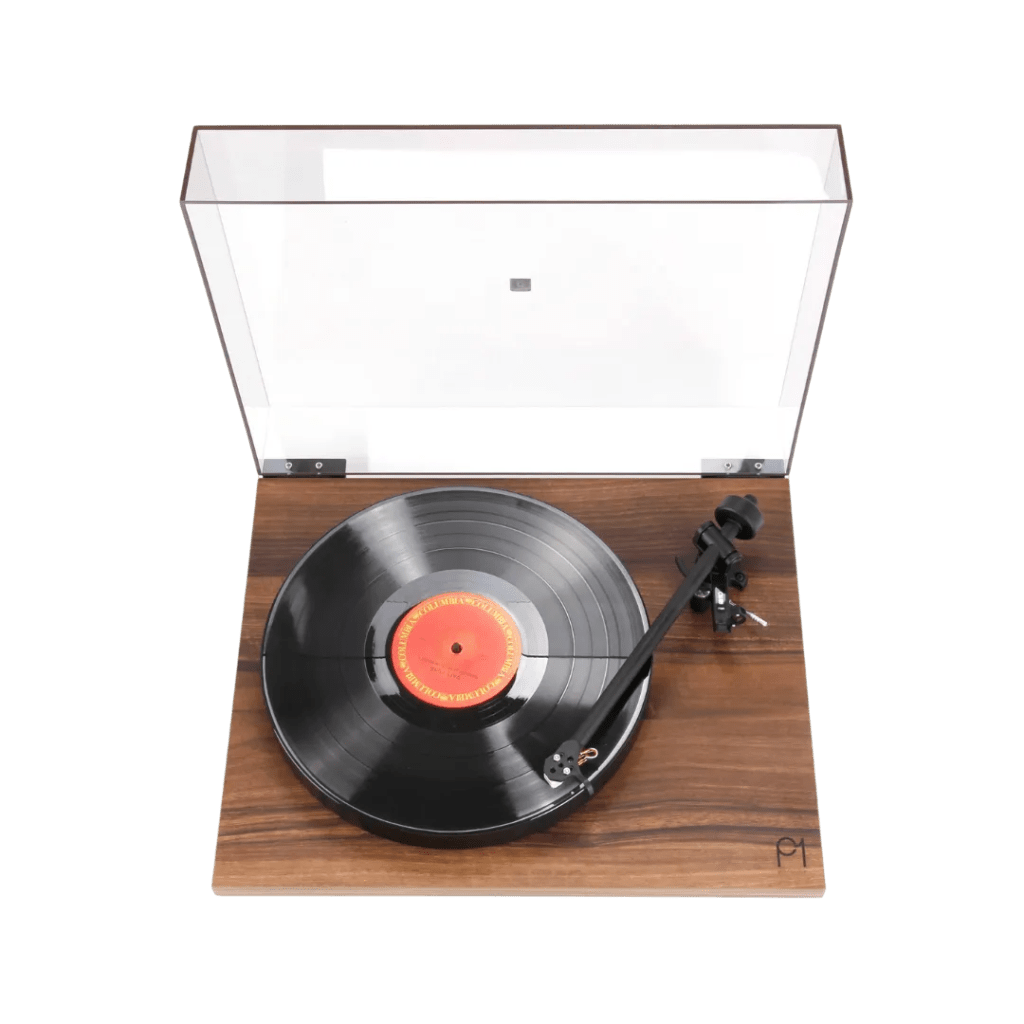
Rega Planar 1
Now we’ve firmly planted our foot in true hi-fi territory, and with it, hi-fi prices.
The Rega Planar 1 is an incredible turntable that’s highly upgradable, carrying Rega’s patented design choices in all the right places: the platter, the tonearm, and the cartridge. It’s a more intricate machine overall, and yes, you’ll hear the difference in the sound.
| Feature | Rega Planar 1 | Fluance RT82 |
|---|---|---|
| Price | $595 on Amazon | $350 on Amazon |
| Turntable Type | Manual, Belt-Drive | Manual, Belt-Drive |
| Plinth Material | High-rigidity laminated plinth in Matt Black, Matt White, or Walnut-effect | MDF with Real Wood Veneer |
| Platter | 23 mm Phenolic Resin (Flywheel-effect) | Precision Aluminum (1.22 lb) |
| Tonearm | RB110 (Rega-designed) | S-Shaped Aluminum with Adjustable Counterweight & Anti-Skate |
| Cartridge | Rega Carbon (Moving Magnet) | Ortofon OM10 (Elliptical Diamond) |
| Preamp | No. For built-in option, see Planar 1 Plus | No (External Required) |
| Bluetooth | No | No |
To recap:
- RT82: The one to beat – best overall value if you want true audiophile features at entry-level pricing.
- AT-LP70x: Perfect if you just want to unbox, plug it in, and spin – the simplest setup.
- Orbit Plus: Almost neck-and-neck with the RT82, but really shines if you prefer its sleek, modern aesthetic (for about $50 more).
- Planar 1: Now you’re firmly in hi-fi land – a genuine audiophile starter deck.
| Feature | Fluance RT82 | Audio-Technica AT-LP70x | U-Turn Orbit Plus | Rega Planar 1 |
|---|---|---|---|---|
| Price | $350 on Amazon | $279 on Amazon | $399 on Amazon | $595 on Amazon |
| Turntable Type | Manual, Belt-Drive | Fully Automatic, Belt-Drive | Manual, Belt-Drive (external belt, manual 33/45 change) | Manual, Belt-Drive |
| Plinth Material | MDF with Real Wood Veneer | Plastic | MDF in multiple color finishes or Solid Oak/Walnut | High-rigidity laminated plinth |
| Platter | Precision Aluminum (1.22 lb) | Die-Cast Aluminum | Grooved Acrylic | 23 mm Phenolic Resin (flywheel-effect) |
| Tonearm | S-Shaped Aluminum with Adjustable Counterweight & Anti-Skate | J-Shaped, Fixed | OA3 Gimbal (Straight), Internal Anti-Skate, Adjustable Counterweight | RB110 Tonearm (Rega design) |
| Cartridge | Ortofon OM10 (Elliptical Diamond) | Audio-Technica AT-VM95C | Ortofon OM5E (Elliptical Diamond) | Rega Carbon (Moving Magnet) |
| Preamp | No (External Required) | Built-In, Switchable | No (External Required) – Plus model has Built-In | No (External Required). Planar 1 Plus version has Built-In |
| Bluetooth | No | No | No | No |
Is the Fluance RT82 Right for you?
Here’s the deal: the RT82 is not for everyone, and that’s exactly why it’s so good.
- If you’re the type of listener who wants to get serious about vinyl (not just background noise), this turntable makes a lot of sense.
- It’s built for people who are ready to put together a real system (turntable + amp + speaker) instead of relying on an all-in-one box.
- You’ll appreciate it most if you care about things like record wear, better detail in the sound, and having the ability to tweak and upgrade down the line.
Who it’s not for:
If you just want something cheap and cheerful for a dorm room or a casual vibe, this is overkill.
Same if you need “plug it in and play it instantly” convenience. The lack of a built-in preamp means you’ll need an amp or powered speakers with phono input. If that makes you groan, you may be better off with something like the AT-LP70x.
When It Makes Sense
Think of it this way, the RT82 makes the most sense if:
- You’re moving past cheap record players and want something that feels “real.”
- You’re okay with taking one extra step (getting an amp or phono stage).
- You want a turntable that can stay with you for years instead of a disposable starter.
When it doesn’t make sense:
- You care less about sound quality – you just want something to spin records while you cook dinner.
- You hate the idea of buying multiple components. (Turntable + amp + speakers can feel like “too much.”)
- You really just want Bluetooth convenience and nothing else.
Why It’s Worth Considering
Here’s the big takeaway: the RT82 might cost more than the cheapest options, but it saves you from the frustration of buying twice.
Cheaper turntables cut corners:
- Plastic platters → shaky speed stability.
- Fixed tonearms → no control, more record wear.
- Budget cartridges → duller sound that makes every record feel flatter than they should.
The RT82 avoids all of that while still staying in the “entry-level” price range. It’s basically your shortcut to a mid-tier experience without spending mid-tier money.
Conclusion: Is It Worth It?
Yes, we obviously think so. The RT82 just hits that rare sweet spot where the money you put in feels like it goes twice as far.
It’s not pretending to be “budget chic” or some disposable starter kit. It’s a real turntable with the kind of features you usually don’t touch until you’re shopping way higher up the ladder. Solid build, real upgrade paths, and sound that actually makes you sit up and notice, that’s what you’re getting.
The other thing? It’s fun. It makes the ritual of playing records feel intentional, not just convenient. You don’t push a button, you drop the tonearm slowly onto the record which starts the song, you set the counterweight so its not tracking so aggressively on the grooves. That’s something the cheaper decks can’t capture.
Bottom line: if you’ve been sitting on the fence about upgrading, the RT82 is the move. It’s not the cheapest, and it’s not trying to be, it’s the entry point into vinyl done right.
If you want the best way to create your setup with the RT82 or heck, even the LP70x or any other solid, beginner, turntable, check out our Setup Builder.
It’s a free tool that let’s you build your vinyl setup from the top components on the market, while we check for compatibility and give you a score on the combination you selected. We also keep the track of the latest sale prices, and update the list based on the latest top rated products. Check out a quick preview of how it works below:
If you want the best RT82 setup in our eyes check out the Elevated Audiophile’s Den.
If you got this far and thought, “Okay, this is cool… but it’s a lot,” that’s totally fair.
Maybe you do just want one box you can drop on a shelf, plug in, and play, no extra gear, no settings, no deep dive into components. And yeah, the internet loves to scream “never buy an all-in-one,” but the truth is more nuanced: there’s a ton of junk out there, and a handful of all-in-one record players that are genuinely great for the right person.
The real challenge isn’t avoiding them, it’s sorting the trash from the few safe, solid options. For you, we would like to introduce you to our good friend the “All-in-one” matcher.
Based on a few criteria, we can filter the ones that actually sound good for the price, and give you clear upgrade paths if you ever want to step up later.
Either way, congrats on getting into your physical media journey, we are confident you will never turn back.