
Picture this: You’re in a thrift store and there it is. Out of the corner of your eye you spot THAT grail. Maybe it’s a Beatles album, or some iconic cover art that grabs your attention – but now you’re all in. You buy it, you’re hyped, and then you realize the obvious problem – you need a record player.
So you go online…and there it is: the $50 suitcase record player. It’s cheap, it looks retro, and it promises to spin your records. Looks promising, so you go ahead and checkout without taking much of a second look.
But here’s the catch: buying a $50 suitcase player is like ordering a McDouble and expecting a gourmet dinner at a Michelin star restauraunt. Yeah sure, it’s food, it works, it’s built for convenience (like rolling through the McDonald’s drive-through) but it’s not quality, far from it. And it’s definitely not the same experience you were imagining.
Same idea here. These record players are designed to be affordable, not accurate, and definitely not durable.
This guide isn’t here to tell you your Crosley or Victrola is trash. It’s here to show what you should actually know about suitcase record players before you buy, how to make your player safer if you already own one, and what to look for if you ever decide to upgrade.
Table of Contents
In this post, we cover all things suitcase record players, broken down into the following sections:
- Here’s why Suitcase Record Players are “Bad“
- How to Pick The Right Beginner Record Player
- Victrola Re-Spin vs. Fluance RT82: A Case Study in Build Quality
- Investing in a Better Turntable: Why It’s Worth It
- The Verdict: Suitcase Record Players vs. Quality Turntables
Affiliate Disclosure: We’re a small team of vinyl enthusiasts – if you get value from our insights, using our affiliate links (including Amazon Associates) helps us earn a commission and keep the lights on at no extra cost to you. Thank you for supporting Recordbuilds.com
Here’s why Suitcase Record Players are Bad
The giveaway: the bright red stylus, the skinny tonearm, and that lightweight plastic platter – all basically fused into the same cheap mechanism.
The most important skill you can learn when shopping for a record player is spotting these three giveaways. It’s the same bargain-bin turntable guts reused across a ton of suitcase players and “all-in-one” models.
Here’s what usually happens:
- The needle wears out fast
- The tonearm doesn’t track consistently
- And there’s no real way to fix it because there’s nothing to adjust

This all-in-one plastic setup isn’t just cheap – it’s risky. It’s all one little mechanism that’s built to be “good enough” on day one… and basically impossible to improve after that.
If you see something like this, just think of those famous three words in big black text: “MADE IN CHINA” Not literally (though it probably was made somewhere in Southeast Asia). But the feeling: Cheap. Flimsy. Breakable. Like the toys we grew up with that lasted two days and then fell apart.
And yeah – that’s harsh. But it’s also the point.
At the end of the day, these players are more toy than tool. Which is ok if that’s what you want! If you’re only spinning a few thrift finds once in a while, and don’t care much for getting that vinyl sound quality…you’ll be ok.
But if you’re building a real collection and playing records regularly, stepping up even a little changes everything. Around $200-300 gets you real materials, real tracking, and a turntable that won’t fight you every time you press play.
Better sound, fewer skips, and way more peace of mind for your records.
How to Pick The Right Beginner Record Player
If you’re serious about building a vinyl collection (and you want your records to sound good for a long time), it’s worth getting a better record player.
Because $50 feels like a steal… until you’re replacing the needle, fighting skips, and upgrading anyway.
So here’s what actually matters when you’re shopping:
Real materials (not toy plastic)
You don’t need to be an audiophile. Just look for a record player that feels like it was built to last.
- a tonearm that’s metal (not flimsy plastic)
- a platter that has some weight (not a lightweight plastic disc)
Heavier, sturdier parts = smoother playback and fewer issues.
You want basic adjustability
This is the big difference between “toy” and “tool.”
A good record player lets you make small adjustments so it plays nicely with your records. Ideally, you want:
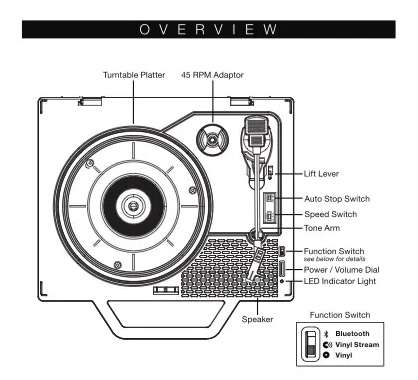
- a real counterweight (the little weight/knob at the end of your tonearm that makes sure the needle isn’t pressing too hard on your vinyl)
- anti-skate (the little dial towards the base of your tonearm that makes sure it doesn’t pull inward and wear grooves weird)
Bonus points if the stylus is replaceable (so you can swap it later instead of buying a whole new player).
Look out for built in preamps!
This is a super convenient feature you should look out for when shopping for your first record player.
Basically this will let you connect to external speakers without needing another piece of equipment. Saves money and is a simpler setup.
How to Pick The Right Beginner Record Player
So basically, I want you to keep an eye out for
- Sturdier materials
- a counterweight/anti-skate
- Built in preamp
You don’t absolutely need all three of these things, especially for your first record player. But, if you can check all three of these boxes, I don’t care what people on reddit forums say, you are in a decent starting spot.
But it’s still very difficult to choose the right one – much harder than it might seem once you click away from this post and start browsing all the options. If you want the easiest way to narrow down to the best 2-3 options based on your preferences, check out our Record Player Guide.
You basically just select the things that you want in your record player (good budget, solid sound, bluetooth, etc.) and it will match the features to the best options on the market. Super simple – and a good way to not spend too much time researching your picks. Check out how it works below:
Victrola Re-Spin vs. Fluance RT82: A Case Study in Build Quality
Ok but let’s say you want more than fairly decent.
You wan’t to put your best foot forward when getting into vinyl, then a “real” component turntable might be for you.
Let’s dig into the comparison between two popular options at very different price points: the Victrola Re-Spin, a budget suitcase-style record player, and the Fluance RT82, a higher-end, entry-level turntable.
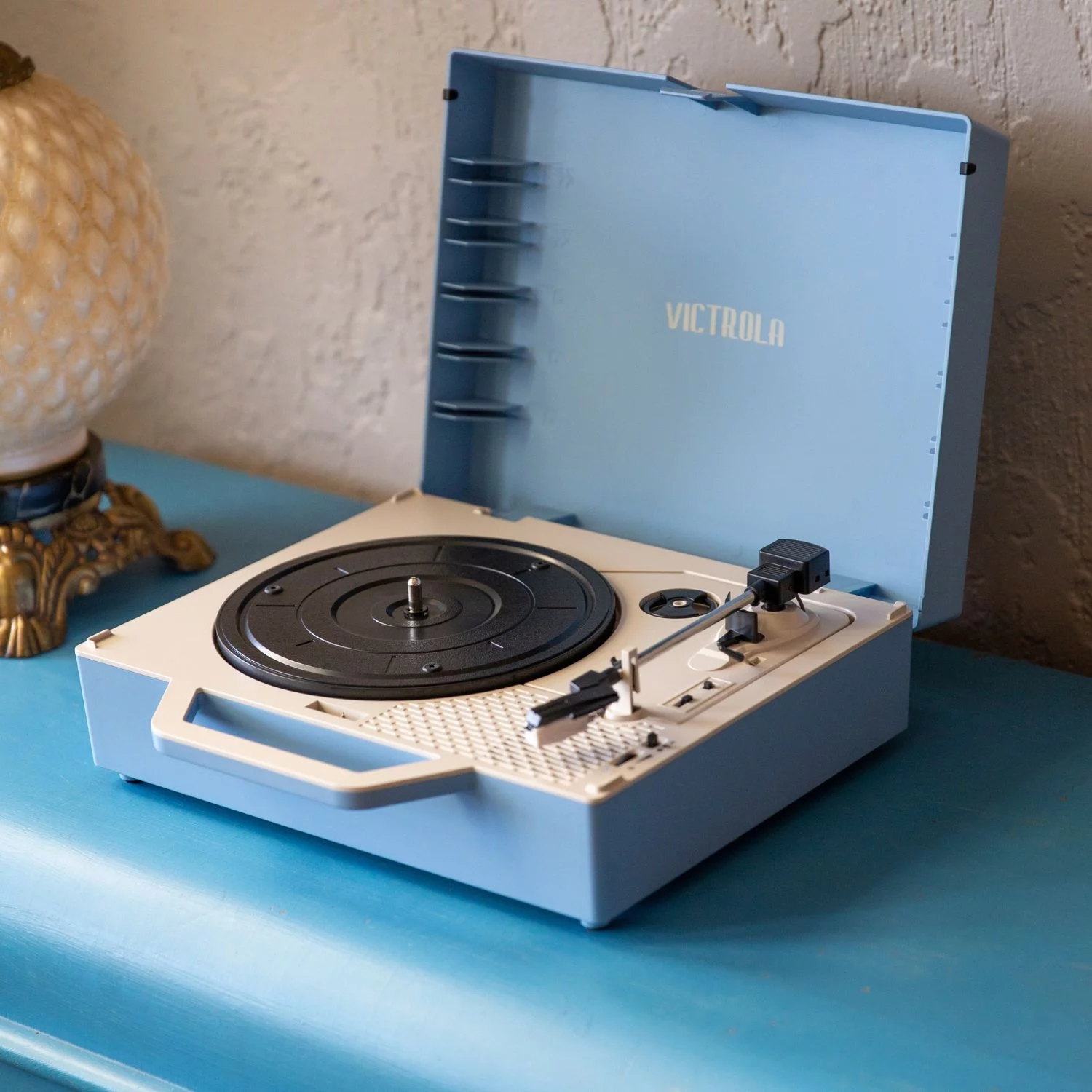
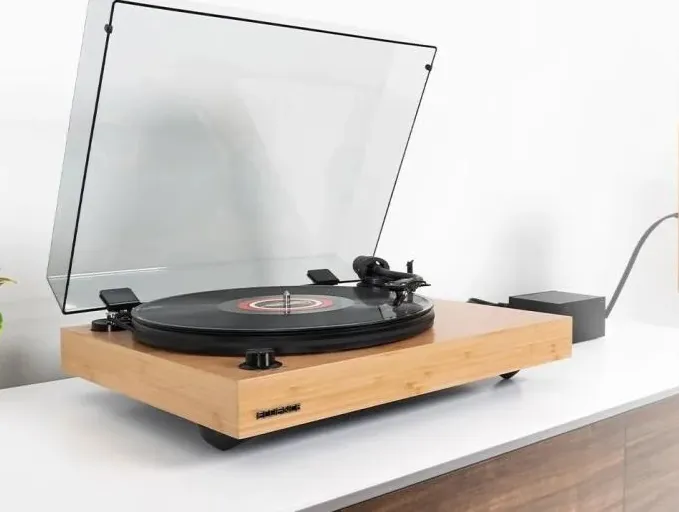
Victrola Re-Spin: At Least It’s Portable!
The Victrola Re-Spin is basically marketed as a “fun, modern suitcase player.” It’s around $100, it has Bluetooth, built-in speakers, and a bunch of nice-sounding phrases like “Vinyl Stream Technology.” They also lean into the sustainability angle – lighter design, recycled plastic, etc.
On the other hand the RT82 is around $300, so yeah – more money. But it’s also a real entry-level turntable, and the difference is you can actually see what you’re paying for. They give you real specs, and the parts are built for sound quality and consistency, not just convenience.
Here’s the simple breakdown:
Platter
- Re-Spin: No real details. Usually that means lightweight plastic, which can lead to unstable speed.
- RT82: A heavier aluminum platter. More stability = smoother playback.
Tonearm
- Re-Spin: Plastic, no real adjustability.
- RT82: Metal tonearm with a real counterweight and anti-skate, so the needle can actually track properly.
Drive / motor
- Re-Spin: Belt drive, but not much detail on how well it controls vibration or speed.
- RT82: Belt drive with better motor control and isolation, so it’s less affected by vibration.
Cartridge / needle
- Re-Spin: Usually unspecified, which often means “basic ceramic-style setup.”
- RT82: Comes with a known, legit cartridge (Ortofon OM10), which tracks better and is nicer to your records.

So yeah that extra $200 goes a long way. It’s that difference between Mcdonalds and a Michelin star restaurant. With a real turntable you will feel the sound quality, performance, and aesthetic jump. If you plan to listen to records more than every once in awhile, this is definitely the type of record player you want to start with.
Otherwise, you are going to find yourself wanting to upgrade from the suitcase soon, or giving up on the hobby altogether.
Investing in a Better Turntable: Why It’s Worth It
So that low price of a suitcase player is tempting. I get it.
But if you plan on buying more than a handful of records, a better turntable usually saves you money long-term. Because the upgrade is going to happen anyway. A real turntable gives you:
- better sound (immediately)
- fewer skips and weird issues
- and way more peace of mind that you’re not slowly cooking your records
And the best part is, a good turntable can last a long time. Like, years and years. It’s the kind of thing you buy once, take care of, and just enjoy – while your collection grows.
Price Range
A good entry-level turntable is usually going to be around $200-300 new. Yeah, that’s more than a suitcase player. But it’s also the difference between “this is kind of a toy” and “this is a setup I can actually live with.”
You get better sound, fewer skips, and a turntable that isn’t constantly fighting you. You can also go used and save a bunch. Facebook Marketplace and Reverb can be gold.
Just know this: buying used is a little sketchy if you’re brand new.
Audio gear is still tech. Stuff can be worn out, misaligned, or quietly broken. And if you don’t know what to look for, you can accidentally buy someone else’s problem.
If you want the simple rule:
- New = easier, safer, less headache
- Used = cheaper, better value, but higher risk
And zooming out – think of a real turntable as a long-term buy. You’re not just paying for better sound. You’re paying to protect your records. Records aren’t cheap. Replacing a single damaged album can cost as much as the price difference between a suitcase player and a legit entry-level turntable.
So spending a bit more up front usually saves you money (and frustration) later.
Go-To Entry Level Turntables
If you want a “real turntable” without going full nerd, start with the brands that consistently just work.
Audio-Technica and Fluance are the two safest bets. We feature both in our buider because they’re reliable, easy to live with, and they don’t come with the usual suitcase-player headaches.
Other solid options depending on budget and vibe:
- Insignia
- U-Turn Orbit
- And yes – even Crosley (they make real turntables too, not just suitcase players)
If you want the fastest path to a setup that actually makes sense, use our Setup Builder.
Decide a number that you would be willing to spend. Filter by features/brands/sales to match a turntable with speakers. We’ll let you know if the combo actually works together and give you rating on where your setup thrives, and where it could be improved.
The Verdict: Suitcase Record Players vs. Quality Turntables
At the end of the day, suitcase record players aren’t inherently bad – they just serve a different purpose. They’re fun, affordable, and can be a neat intro to vinyl for casual listening or pure nostalgia. If you’re set on a suitcase player, that’s totally fine.
But if you want to actually learn this stuff and start building your own setup the right way, use our Setup Builder. If you do think you want to hang out in the beginner realm for a bit, that’s awesome too! To find your best fit, use our Beginner Record Player guide.
Best of luck! And we are thrilled you are taking the next step into your physical media journey.