
Last Tuesday, I did something incredibly stupid.
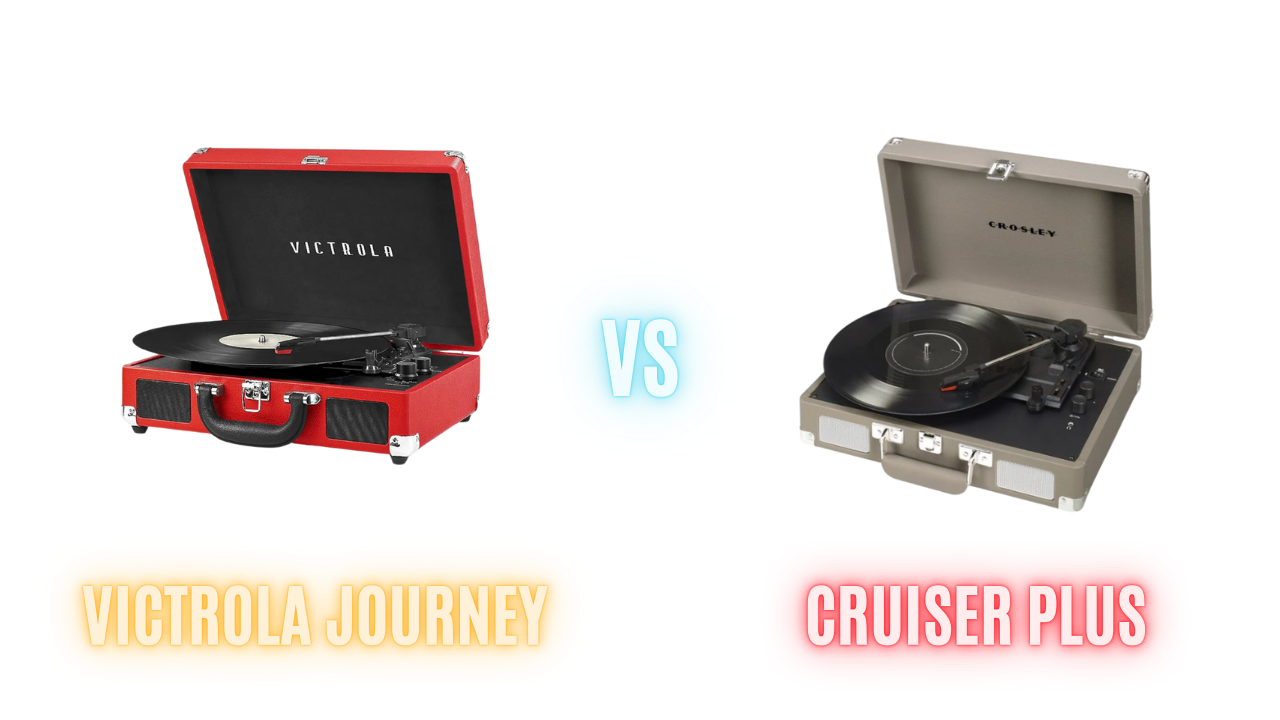
You see, this month, 47 people asked me the same question: “Victrola vs Crosley which one should I actually buy?”
And every time I tried to Google an answer, I got one of two things:
- Reddit threads where someone’s screaming that both will “destroy your records” (they won’t, calm down)
- Amazon reviews split between “this is the greatest purchase of my life” and “this turned my records into jello”
So I said screw it and bought both.
The Victrola Journey and the Crosley Cruiser Plus. Both around $90. Both suitcase-style. Both sitting on my desk right now. Same room. Same outlet. Same record spinning on it.
Three hours later, here’s what actually matters in this Victrola vs Crosley showdown.
The short version: They’re both fine. Neither one’s winning any audiophile awards. But one’s better for most people – and it’s probably not the one you think.
Let me explain.
Table of Contents
In this guide, we’ll cover everything you need to know about picking between the Crosley Voyager and Cruiser Plus, broken down into the following sections:
- Design and Portability
- Build Quality
- Audio Features and Connectivity
- Speaker Quality
- Color Options
- Price and Value
- User Reviews and Reputation
- Conclusion: Victrola vs Crosley – Which Should You Choose?
Affiliate Disclosure: We’re a small team of vinyl enthusiasts – if you get value from our insights, using our affiliate links (including Amazon Associates) helps us earn a commission and keep the lights on at no extra cost to you. Thank you for supporting Recordbuilds.com!
Design and Portability
When you’re looking at Victrola vs Crosley record players, the first thing you’ll notice is how they feel and how easy they are to carry around.
Both are suitcase players. You know the style – little box with a handle you can carry around.
Victrola Journey:

This thing is tiny. And light. Like really light.
2.7 pounds. That’s lighter than most laptops. You could carry this thing with one finger if you wanted to look ridiculous.
The design is super simple. It’s got that classic suitcase look with a handle that folds down. Comes in clean colors like turquoise, blush pink, and black.
Nothing crazy. Just a small box that plays records.
If you live in a tiny apartment or you move it around a lot, this is nice. It takes up almost no space. You could fit this in a backpack if you really wanted to.
Crosley Cruiser Plus:
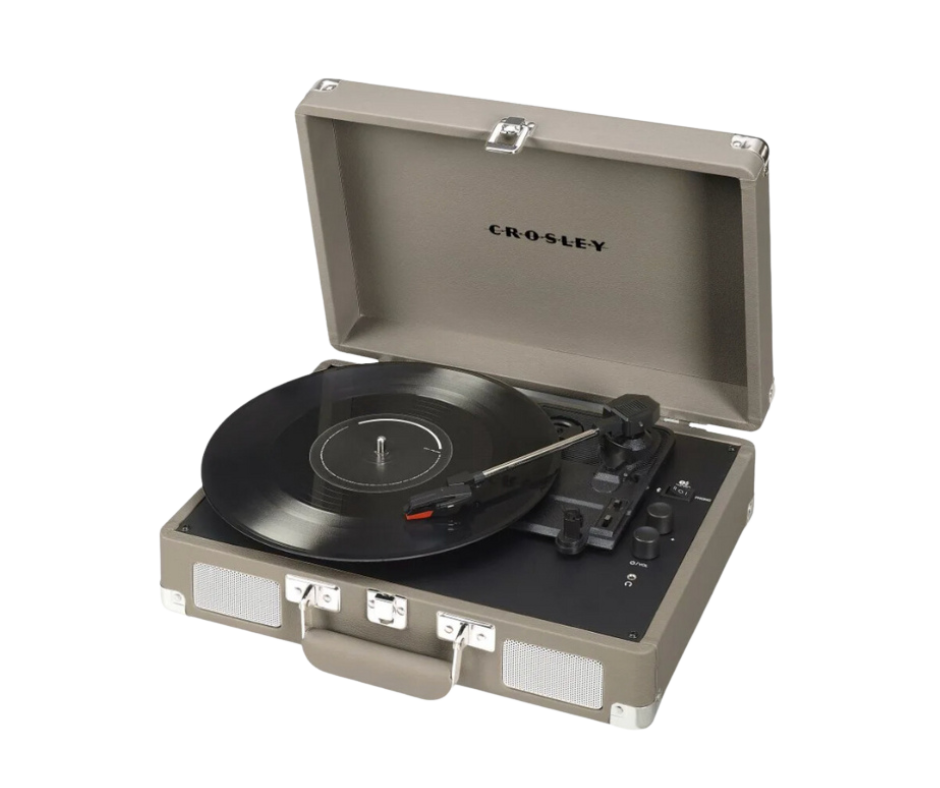
Heavier. About 5.5 pounds.
Still portable – I mean, it’s a suitcase player. But you’ll notice the weight difference if you’re carrying both.
The handle is sturdier. There’s an actual latch that clicks shut (the Victrola’s feels flimsier). And the whole thing just feels more solid when you pick it up.
But here’s where Crosley wins for some people: the colors.
They’ve got SO many options. Tie-dye. Leopard print. Bright pastels. Floral patterns. Solid colors in every shade you can imagine.
If you want your record player to match your room or just look fun, Crosley’s got you covered
Winner: Tie
The Journey is lighter and smaller. The Cruiser looks cooler and feels sturdier.
Which one wins depends on what you care about more. Portability? Journey. Style? Cruiser.
Personally, I’d go Cruiser because I like my stuff to have personality. But that’s just me.
Build Quality
Ok. Let’s talk about what these are actually made of.
And let’s be honest right from the start: neither of these is built like a high-end turntable. They’re not supposed to be. They’re $90 suitcase players made mostly of plastic. We’re not comparing the internal parts here (the tonearm, the cartridge, all that stuff – it’s basic on both). We’re just looking at the shell. The suitcase part.
Victrola Journey:
It’s plastic. Light plastic.
When you pick it up, it feels… fragile? Not like it’s gonna break in your hands, but you can tell it’s not meant to take a beating.
If it sits on your shelf and you only move it once in a while, it’ll be fine. But if you’re the type of person who throws stuff in the trunk of your car or lets it bounce around in a bag, this thing will show wear pretty quick.
The corners aren’t reinforced. The latch is kind of flimsy. The whole thing just feels like it was designed to be light first, durable second.
Crosley Cruiser Plus:
Also plastic. but it’s wrapped differently.
The exterior has this textured finish that feels better in your hands. The corners are reinforced so they don’t crack as easily. And that latch I mentioned? Way better.
When you close the Cruiser, it actually clicks shut and feels secure. The Journey’s latch feels like it might pop open if you look at it wrong.
I’m not saying the Cruiser is indestructible. It’s still a $90 plastic suitcase. But if you’re actually going to move this thing around – to friends’ houses, on trips, whatever – it’ll hold up better.
Winner: Crosley Cruiser Plus
Both are cheaper plastics and neither is winning awards for build quality.
But the Crosley just feels less cheap when you handle it. The wrapped exterior, the reinforced corners, the better latch – it all adds up. If you’re only using this at home and never moving it, doesn’t matter. But if portability is why you’re buying a suitcase player in the first place, get the one that’s actually built to be portable.
Audio Features and Connectivity
This is where the Victrola vs Crosley battle actually gets interesting. And where one of these actually pulls ahead.
Victrola Journey:
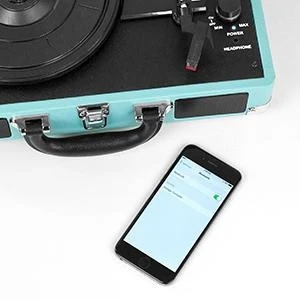
Here’s what it can do:
- Three-speed playback: 33, 45, and 78 RPM. So it plays pretty much any record you throw at it.
- Bluetooth IN: You can stream music from your phone to the Journey’s speakers. Spotify, Apple Music, whatever.
- RCA outputs: Two little red and white cables in the back. You can plug in external speakers if you want better sound.
- No Bluetooth OUT: This is the big one. You can’t send the record player’s audio to wireless speakers.
That last part matters more than you’d think.
Let’s say you’re playing a record and you want to hear it through better speakers. With the Journey, you have to use those RCA cables. That means wires. That means your speakers need to be close. That means you’re stuck with a wired setup.
Crosley Cruiser Plus:

Does everything the Journey does, plus one critical thing:
- Three-speed playback: Same as Journey
- Bluetooth IN: Stream music to it
- RCA outputs: Wired speaker connections
- Bluetooth OUT: Send the turntable’s audio to wireless speakers
That Bluetooth OUT changes everything.
You can play a record on the Cruiser and send it wirelessly to your Bluetooth speaker across the room. Or to your soundbar. Or to whatever wireless speakers you already own.
No cables. No RCA connections. Just pair it and play.
For a lot of people, this is the main reason to pick the Cruiser over the Journey. Modern convenience without giving up the vinyl experience.
Winner: Crosley Cruiser Plus
Bluetooth output is a huge deal.
If you’ve got Bluetooth speakers (and most people do at this point), being able to use them with your record player without running cables everywhere? That’s worth it.
The Journey forces you into a wired setup. The Cruiser gives you options.
Speaker Quality
I’m gonna be straight with you about this.
The built-in speakers on both of these are not good. They’re fine. They work. But they’re not good.
Victrola Journey:
The speakers are small. They’re on the inside of the suitcase.
They sound okay if you’re sitting close to them in a small room. Like, bedroom listening while you’re doing homework or whatever. That’s fine.
But they’re tinny. There’s no bass. They get distorted if you turn them up too loud. And they definitely won’t fill a bigger room with sound.
Again – they work. You can listen to records on them. But you’re not getting the full experience.
Crosley Cruiser Plus:
The speakers are… basically the same.
Similar size. Similar placement. Similar sound quality.
If I’m being completely honest, I couldn’t really tell the difference between the Journey’s speakers and the Cruiser’s speakers when I tested them. They both sound like small, cheap speakers because that’s what they are.
But here’s the thing: with the Cruiser, you don’t have to use them.
Because it has Bluetooth OUT (remember that from the last section?), you can completely bypass these weak built-in speakers and use better ones. Wirelessly.
The Journey? You’re stuck with its speakers unless you want to deal with RCA cables.
Winner: Tie
The built-in speakers are basically identical. Neither one sounds great.
But since the Cruiser gives you an easy way to use better speakers (Bluetooth), it wins on flexibility.
If you’re actually planning to use the built-in speakers and nothing else, there’s no difference. But why would you do that when you could use better speakers with basically no extra effort?
Color Options
This section is short because there’s not much to debate.
Victrola Journey:
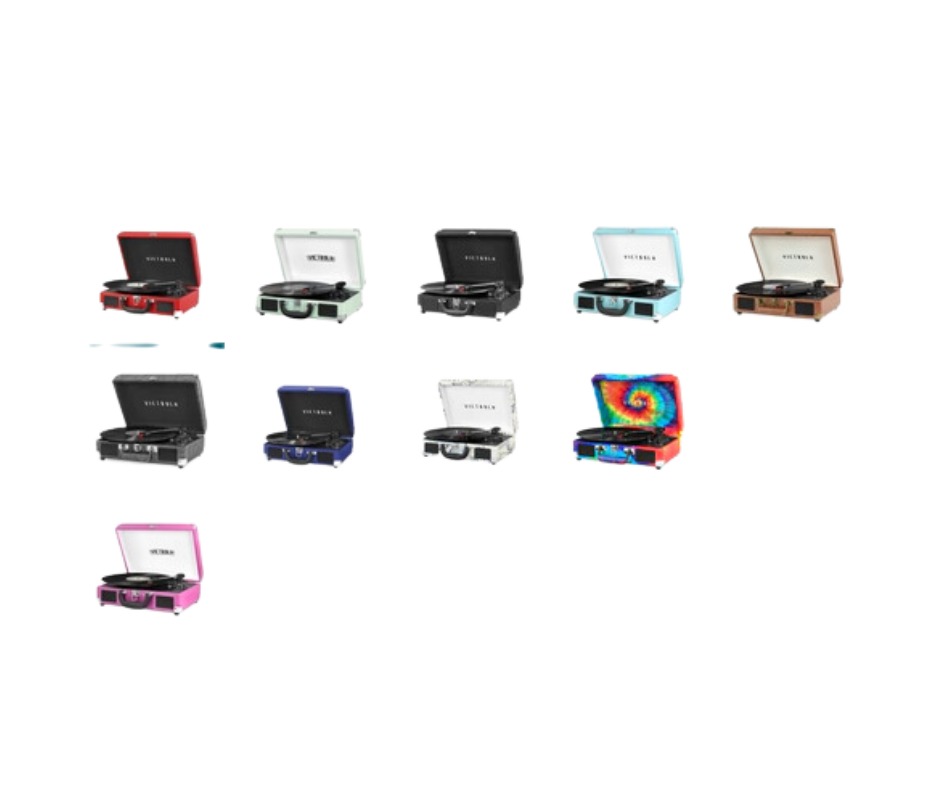
You get a solid number of colors:
- Turquoise
- Blush pink
- Black
- A couple other neutral tones
They’re nice. Clean. Simple. Boring.
If you want something that won’t draw attention or you like minimalist design, cool. These colors are fine.
But there’s not a lot of personality here.
Crosley Cruiser Plus:

Over a dozen color and pattern options.
Seriously. I lost count.
They’ve got:
- Solid colors in basically every shade
- Tie-dye patterns
- Leopard print
- Floral designs
- Pastels
- Bright neon options
- Special edition collaborations
Want your record player to look like a piece of art? Crosley’s got you.
Want it to match your room’s vibe? They probably have that exact color.
Want something weird and fun that makes people go “whoa, where’d you get that?” Also covered.
Winner: Crosley Cruiser Plus
This isn’t even close.
Victrola gives you safe, neutral options. Crosley gives you a whole rainbow of choices.
If you don’t care what your record player looks like, this doesn’t matter. But if you’re buying a suitcase player partly because it’s a cool object to have in your space, Crosley wins easily.
Price and Value
Here’s the simple Victrola vs Crosley math.
Same price. Exactly the same. But one has more features. Better build quality. More color options. And Bluetooth output. That’s the Cruiser. So you’re paying the same money for objectively more stuff.
Victrola Journey:
Crosley Cruiser Plus:
Winner: Cruiser Plus
This is the easiest decision in the whole comparison.
Same price. More features. Better build. More options.
Unless you specifically need the lighter weight of the Journey (and I mean specifically need it), there’s no reason to pick it over the Cruiser when they cost the same.
User Reviews and Reputation
Let’s see what actual people who bought these think.
Victrola Journey:
4.5 stars on Victrola Site
4.2 stars on Amazon
What people like:
- Super affordable
- Easy to set up
- Lightweight and portable
- Looks nice
What people complain about:
- Feels cheap/flimsy
- Speakers aren’t great (surprise, surprise)
- Some worry it won’t last long
- Build quality issues after a few months
The reviews are pretty consistent. People like it for what it is – a cheap, simple way to play records. But they’re not pretending it’s amazing.
Most complaints come from people who expected more than a $90 suitcase player can deliver. If you go in knowing what you’re getting, you’ll probably be happy with it.
Crosley Cruiser Plus:
4 stars on Crosley Site
4.3 stars on Amazon
What people like:
- Great color options
- Bluetooth output is super useful
- Feels sturdier than expected
- Good starter turntable
What people complain about:
- Built-in speakers still aren’t great (again, not shocking)
- Some quality control issues
- Tracking force is heavier than high-end players (but that’s every suitcase player)
Same story as the Journey, basically. People like it. People understand its limitations. Some people complain about stuff that’s true of all budget turntables.
The Bluetooth output gets mentioned a lot in positive reviews. People really appreciate being able to use their own speakers.
Winner: Tie
Both get decent reviews for what they are.
Neither one has people writing poetry about how it changed their life. But both have mostly happy customers who knew what they were buying.
The ratings are close enough that it doesn’t really matter. What matters more is which features you actually care about.
Conclusion: Victrola vs Crosley – Which Should You Choose?
After all that, here’s how I’d actually make the Victrola vs Crosley decision.
| Feature | Victrola Journey | Crosley Cruiser Plus |
|---|---|---|
| Price | $90 on Amazon | $90 on Amazon |
| Design & Portability | Compact suitcase design with foldable carry handle; ultra-lightweight at 2.7 lbs. | Classic suitcase design with vibrant colors and playful patterns; 5.5 lbs with a sturdy handle and latch. |
| Build Quality | Lightweight plastic construction; good for casual use but less robust for frequent transport. | Hand-wrapped exterior with reinforced corners; durable latch for better protection during transport. |
| Audio Features & Connectivity | Three-speed belt drive, RCA output, and Bluetooth input (no output). | Three-speed belt drive, RCA output, Bluetooth input, and Bluetooth output for external speakers. |
| Speaker Quality | Decent sound for casual listening; suitable for smaller rooms. | Comparable built-in speaker quality but offers Bluetooth output for external speaker connections. |
| Color Options | Neutral and muted tones like turquoise, blush, and black for a classic aesthetic. | Over a dozen vibrant and playful color options, including pastels, bold patterns, and special editions. |
| User Reviews & Reputation | 4.5★ on Victrola; ~4.2★ on Amazon. Praised for affordability and ease of use; some durability and sound concerns. | ~4★ on Crosley; ~4.3★ on Amazon. Appreciated for Bluetooth output and durability; slightly pricier historically. |
the Victrola Journey if:
- You absolutely need the lightest option possible (like you’re traveling a lot and every ounce matters)
- You prefer simple, understated colors
- You don’t care about Bluetooth output because you’ll only use the built-in speakers
- You found it on sale and it’s cheaper than the Cruiser
That’s pretty much it. The Journey is fine. It works. But it doesn’t really win at anything except weight.
Get the Crosley Cruiser Plus if:
- You want more color options
- You might connect it to better speakers (either now or later)
- You want something that feels a bit sturdier
- You care about having Bluetooth output
- You want better build quality for the same price
This is the one I’d recommend to most people.
My actual recommendation:
For the same $90, get the Crosley Cruiser Plus.
It does more. It looks cooler (assuming you pick a fun color). It feels better built. And the Bluetooth output alone makes it worth it.
Are either of these “proper” hi-fi setups? No. Will audiophiles on Reddit tell you both are garbage? Probably. Do they destroy your records? Not really, but they’re not great for them long-term.
But here’s the thing: if you’re reading a comparison between two $90 suitcase players, you’re not looking for a $2,000 audiophile setup. You’re looking for an affordable, portable way to play records.
Both of these do that job fine.
The Cruiser just does it better. For the same money.
One more thing
Before you buy either of these, know what you’re getting into.
These are starter turntables. They’re fun. They’re convenient. They look cool. But if you get serious about vinyl, you’ll probably want to upgrade eventually.
The good news? We’ve got guides for that.
Check out our full suitcase player guide for more options, tips on making them sound better, and clear upgrade paths when you’re ready. No audiophile gatekeeping. Just honest help.