
A needle dragging through a plastic groove should not be able to make music. And yet, somehow, it does.
No power. No software. No wireless signal. Just a tiny stylus, a spinning disc, and sound filling a room. It feels almost fake when you stop and think about it.
And most people never do. They just drop the needle and accept the magic.
But will say the answer is actually much simpler than you might think. So, if you’ve ever wondered why dropping a needle on a spinning disc actually makes music happen, you’re in the right place. Let’s break it down.
Table of Contents
In this guide, we’ll cover everything you need to know about how do vinyl records work.
- What Is a Vinyl Record?
- How Music Gets Pressed Into a Vinyl Record
- How a Turntable Reads the Groove
- Why Vinyl Sounds the Way It Does
- The Components That Make It Happen
- Conclusion: Why People Still Love Vinyl
What Is a Vinyl Record?
A vinyl record isn’t just a black plastic circle – it’s a storage device for sound. The grooves on a record are literally physical recordings of sound waves. That’s basically the simplest way to explain how do vinyl records work.
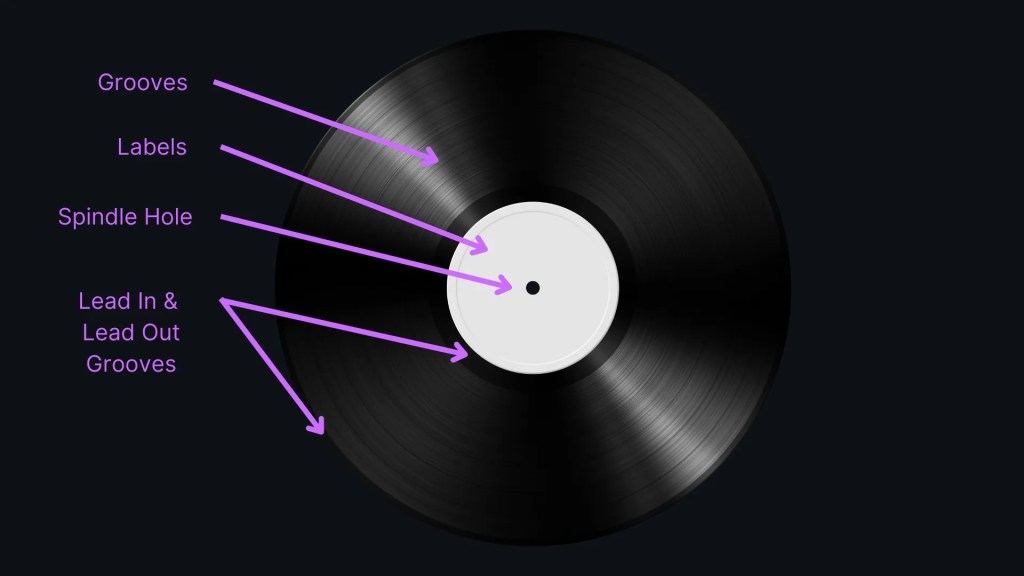
The basic anatomy of a vinyl record includes:
- Grooves – These are microscopic ridges carved into the record’s surface.
- Labels – The middle part with the artist and album info.
- Spindle Hole – The center hole that fits onto the turntable.
- Lead-in & Lead-out Grooves – These help the stylus find the music and exit smoothly.
Records come in different sizes (7-inch, 10-inch, 12-inch) and speeds (33⅓, 45, and 78 RPM). The size and speed determine how much music can fit on each side.
How Music Gets Pressed Into a Vinyl Record
Imagine you’re making a stamp to press your handprint into clay. Vinyl records work kind of the same way-except instead of a handprint, it’s sound waves getting pressed into plastic.
Here’s how it happens:
- 1. Recording the Music – First, musicians play their instruments and sing. Microphones capture those sounds and turn them into an electrical signal.
- 2. Making the First Copy (Master Disc) – This electrical signal is sent to a machine called a lathe, which has a super-sharp needle. This needle carves tiny bumps and grooves into a blank disc, kind of like drawing a wavy line that represents the music.
- 3. Turning That Copy Into a Stamp (Stamper Disc) – The master disc isn’t used to make records directly. Instead, it’s turned into a metal mold called a stamper. Think of this like a cookie cutter—it’s the tool used to press the final shape.
- 4. Pressing the Vinyl Record – Melted plastic (vinyl) is squished between two of these metal stampers. They press the grooves into the plastic, creating an exact copy of the original master disc. Once it cools down, you’ve got a vinyl record!
That’s it. The grooves on the record are little bumps and ridges that match the original sound waves from the music. When you play it on a turntable, the needle moves through those grooves and turns them back into sound. Pretty cool, right?
How a Turntable Reads the Groove
This the moment where “how do vinyl records work” goes from mystery to ohhhhhh.
So we’ve got a vinyl record with music physically etched into it. Now, how does a turntable turn those grooves into sound?
It all starts with the stylus (aka the needle). When you lower the tonearm onto the spinning record, the stylus sits inside the groove and moves along its ridges. Every bump and curve in the groove makes the stylus vibrate.
That vibration then gets sent up to the cartridge, which is the small box at the end of the tonearm. Inside, magnets and coils work together to convert those tiny movements into an electrical signal.
But that signal isn’t strong enough on its own, which is where the preamp comes in-it boosts the signal so it’s powerful enough to send to your speakers. The amplifier takes it from there, turning it into sound waves that blast through your speakers.
And just like that, the music that was physically carved into the grooves comes back to life:

Turntable → Phono Preamp → Power Amplifier → Speakers
If you remember nothing else, this chain is how do vinyl records work in real life.
Why Vinyl Sounds the Way It Does
Ever heard someone say vinyl sounds “warmer” than digital? That’s not just some made-up audiophile nonsense-there’s actual science behind it.
Here’s why vinyl has its own unique sound:
1. Analog Waves vs. Digital Chunks
- Vinyl is analog, meaning it captures the full, continuous sound wave.
- Digital music, on the other hand, is made up of tiny samples—like a series of snapshots strung together. Even at high quality, it’s technically missing some of the original sound.
2. Less Compression = More Dynamics
- Digital music (especially streaming) compresses sound to save space. This flattens out some of the peaks and valleys in the audio.
- Vinyl is mastered with less compression, meaning the louds hit harder, the softs feel softer, and everything in between feels more natural.
3. Vinyl’s Little Imperfections Add Character
- Surface noise, pops, crackles—they’re all part of the experience.
- Some call it distortion, others call it charm. Either way, it makes vinyl feel more organic and alive.
4. The Playback Process Itself Matters
- A needle physically moving through a groove creates a different kind of resonance than digital playback.
- The sound that comes off a record isn’t just about the recording—it’s about how the stylus interacts with the grooves in real time.
The Components That Make It Happen
Not all turntables sound the same. Some setups make records sing. Others just make them suffer.
Here’s what actually makes a difference:
The Stylus (Needle)
- A sharper, more precise stylus digs deeper into the grooves, pulling out more detail without wrecking your records.
- Cheap needles? They grind away at the grooves, wearing them down faster and muddying the sound.
The Cartridge
- This little piece turns vibrations into sound—so yeah, it’s kind of a big deal.
- Some cartridges lean toward warmth, others bring out clarity—your choice, but a good one can completely change your listening experience.
The Tonearm
- Keeps the stylus steady and tracking smoothly. Bad tracking = bad sound + damaged records.
- A poorly designed tonearm will have the needle skating all over the place, which means mis-tracking, distortion, and unnecessary wear on your vinyl.
The Platter
- This is what the record spins on, and generally, the heavier is better.
- A solid platter absorbs vibrations, keeping playback stable and distortion-free. A flimsy plastic one? Get ready for speed issues and muddy sound.
The Motor
- If your motor isn’t rock solid, your record won’t spin at a steady speed.
- A cheap motor = pitch fluctuations, warbly sound, and an overall messy experience. That’s why higher-end turntables invest in direct-drive or precision belt-drive systems.
- Every piece of the system matters. Get one thing wrong, and the whole experience falls apart.
This is why people obsess over their turntable setup. It’s not just about the music—it’s about getting every last drop of sound out of those grooves.
Conclusion: Why People Still Love Vinyl
It’s big. It’s fragile. It takes actual effort. By now, it should be a museum relic.
But somehow it’s still here. And not just surviving, winning.
So here’s the honest answer it’s literally the opposite of scrolling. You pick one record, commit to it, and let the room do its thing for 20 minutes.
And once you have that first “ohhhh ok I get it” moment with physical media, it’s hard to forget.
If you want to get into it, our whole mission at Recordbuilds is to make this as easy as possible for anyone who wants to listen to vinyl.
Even if you’re not ready to buy anything today, poke around our Setup Builder to see what a “good” setup actually looks like. Or check out our Completed Builds for real examples of systems and rooms. And if you’re still in the “keep it simple” phase, our Beginner Record Players guide is a solid starting point too.
All-in-One Record Players
Keep it simple.
One box, built for small spaces and easy listening.

Get a safe, compact pick in minutes
DIY Setup Planner
Build it your way.
Compare parts and personalize your setup.

Your room, your gear, your way.