
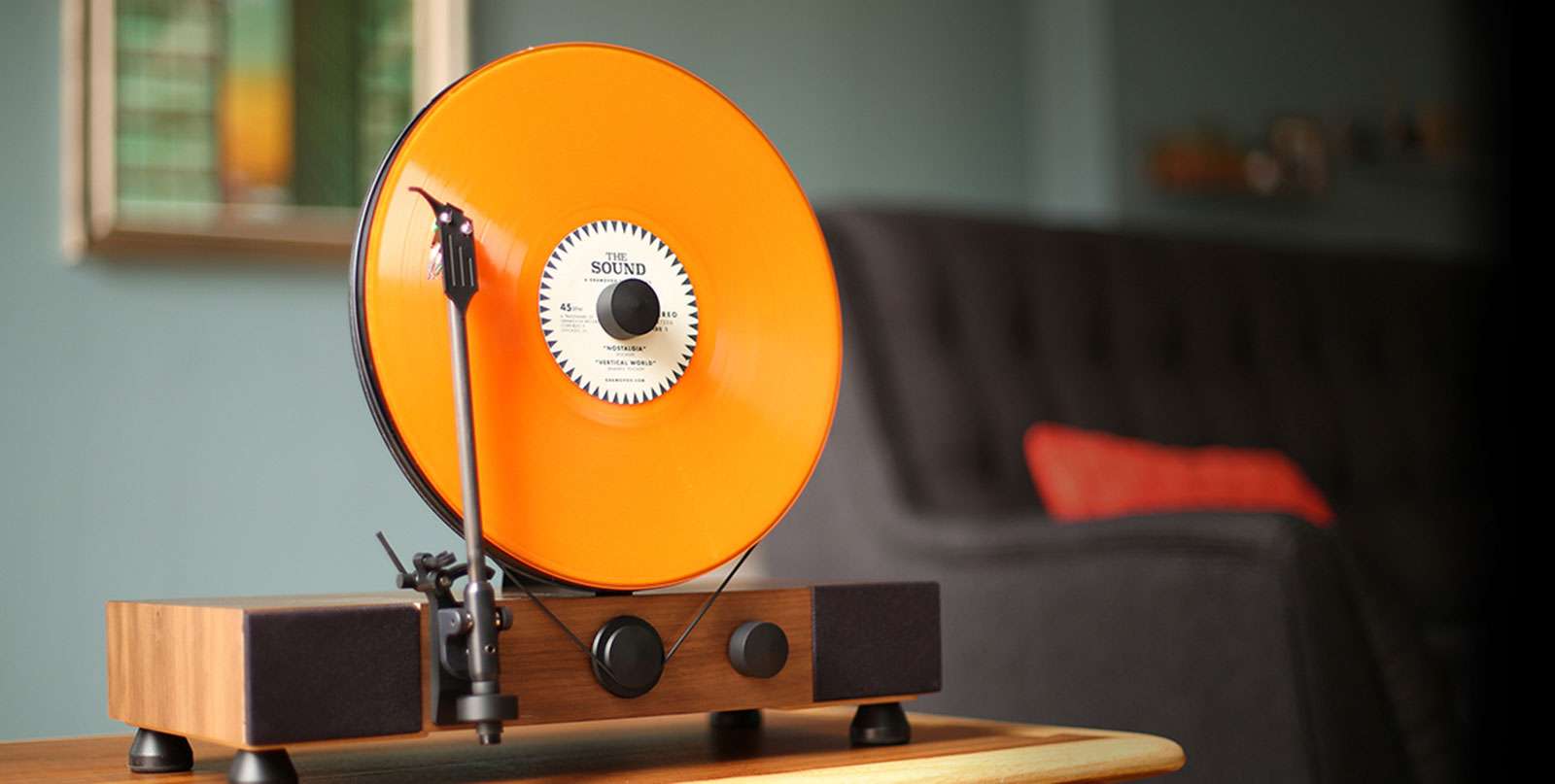
Part sculpture, part sound machine. All statement.
You’ve seen them on your feed-how could you miss them? Records spinning upright like art, glowing under moody lights. Mounted on walls, perched on shelves, and looking more like a gallery piece than a music player.
The Vertical Record Player looks unreal. They stop people mid-scroll—and in real life, too.
But here’s the question: do they actually work? Or are they just overpriced eye candy that wreck your vinyl?
Table of Contents
In this guide, we’ll cover everything you need to know about the vertical record player. But if you just want to check out the few that don’t just look good but actually deliver, we rounded them up here.
- What Are Vertical/Wall Mounted Record Players and Why Are They Blowing Up?
- How Vertical/Wall Mounted Record Players Actually Work—and Why It’s Way Harder Than It Looks
- What to Look for in a Good Vertical Turntable Vertical/Wall Mounted Record Player
- Only the Best Vertical Record Players
- Flat Might Be Boring, But It Works
- Conclusion: Are Vertical Record Players Worth It?
Affiliate Disclosure: We’re a small team of vinyl enthusiasts—if you get value from our insights, using our affiliate links (including Amazon Associates) helps us earn a commission and keep the lights on at no extra cost to you. Thank you for supporting Recordbuilds.com!
What Are Vertical Record/Wall Mounted Players and Why Are They Blowing Up?
Like you, we were curious.
Could these things actually play my records without skipping? Would they hurt your records? And most importantly—are any of them actually worth buying?
Well, let’s start here. You’ve got a record standing straight up, spinning mid-air. No platter, no gravity assist. Just a clamp, a stylus, and some clever engineering trying to make it all work. Sounds wild, right? That’s because it is. And whether that’s genius or gimmick depends on a few key details.
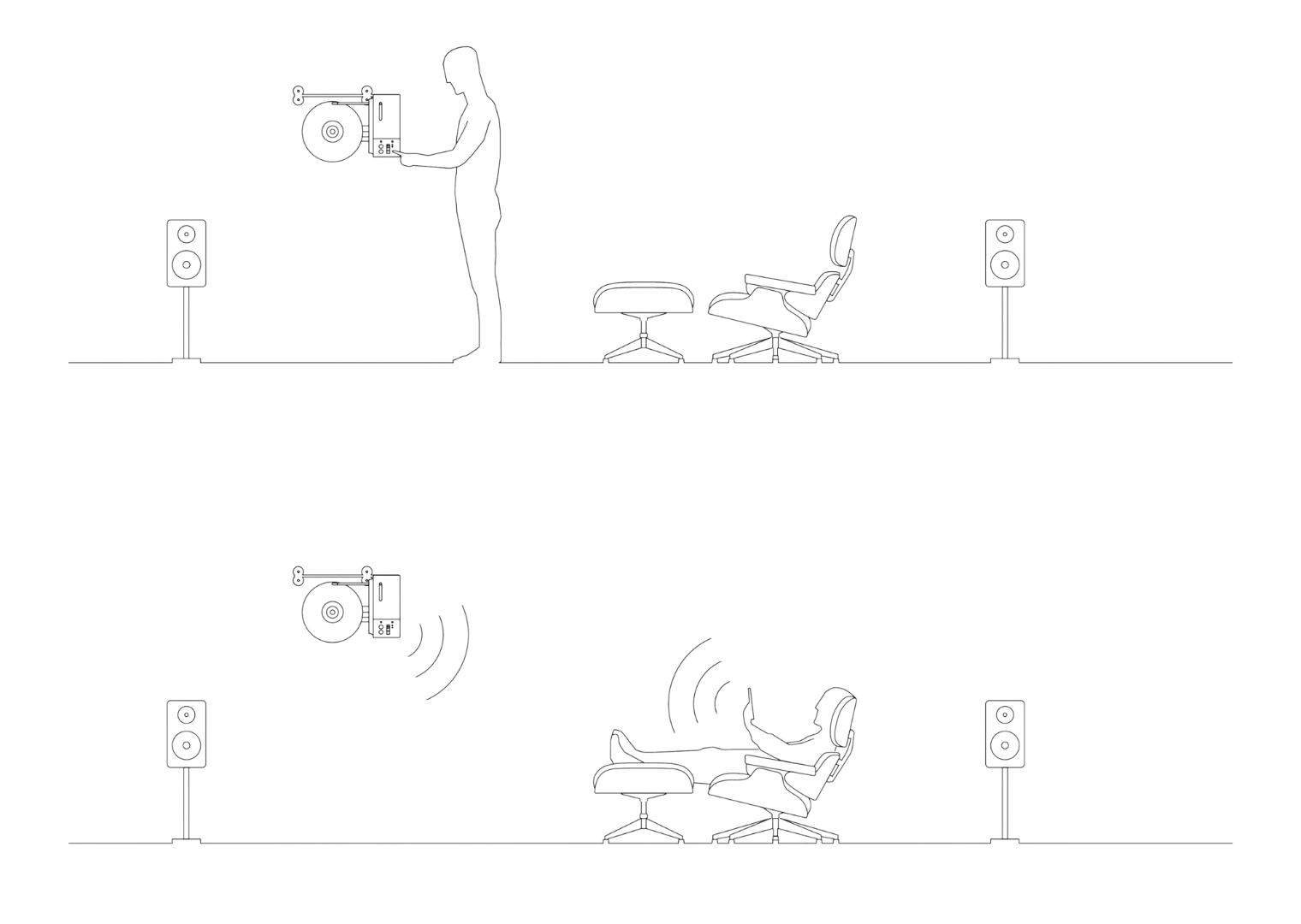

Images from Oscar Olsson
But now let’s just wait a minute! Why is everyone suddenly obsessed with these things?
I mean, we think it’s simple…they look incredible.
Vertical turntables turn your records into a statement piece. More than just a way to play music, they’re décor. Paired with moody lighting and a clean setup, they make any space feel like a high-end listening lounge.
There’s also the space-saving appeal, which is kind of true but mostly just a bonus. Sure, they take up less surface area, which might help in a small apartment, but let’s be honest, that’s not why people are buying them. It’s all about the aesthetic flex.
At the end of the day, vertical turntables prioritize looks over function. They’re undeniably cool, but before you grab one, let’s talk about what you’re really getting into.
How Vertical/Wall Mounted Record Players Actually Work—and Why It’s Way Harder Than It Looks
Spoiler: It’s Not Simple
Let me first show you this neat video from Gramavox showing the mechanism:
Pretty cool, right? But also…kinda complicated.
Vertical turntables still follow the same basic idea as traditional ones: a record spins, the needle tracks the grooves, and sound comes out. But when you flip the whole thing upright, everything gets harder.
1. Gravity Isn’t Your Friend Here
On a flat setup, gravity is your friend—it holds the record steady and helps the needle stay in the groove.
- It presses the record flat against the platter.
- It helps the tonearm apply just the right amount of pressure to keep the stylus (needle) in the groove.
- It keeps the stylus from bouncing or skipping, especially during bass-heavy parts or light vibrations.
But when you flip that setup vertically? Gravity starts pulling everything sideways—away from where it should be.
- The record wants to fall off the spindle unless it’s clamped tightly.
- The tonearm can’t rely on gravity to track the groove evenly, so you need springs or counterweights to simulate that balance.
- If those aren’t calibrated perfectly, it leads to mistracking, skips, or even long-term groove damage.
In short, vertical setups force the player to fight gravity every second it’s on. That’s why good engineering matters so much here—and why cheap versions tend to struggle.
2. Enter The Clamp
A vertical record player relies on a clamp (or magnet) to hold the record in place. No platter means gravity wants to pull the record down—and the clamp is what keeps it spinning.
It usually works, but not always smoothly. You’ll need to line it up, lock it in, and hope it’s snug.
Here’s generally how it goes:
- If it’s loose? The record wobbles.
- If it’s uneven? Your stylus can mis-track.
- If it’s cheap? Expect skips or sound issues.
3. Tonearm Drama
In a normal setup, gravity helps the tonearm apply just the right pressure. On a vertical turntable, it’s working against you. So manufacturers use springs, weights, or fancy pivot systems to compensate.
Here’s the tonearm battle:
- Too much pressure? You wear out your records.
- Too little? The needle skips or dances across the grooves.
- Cheap engineering? Expect tracking issues and distortion.
Bottom line: balancing the tonearm vertically is way harder—and bad tuning can mess with your vinyl.
When I was digging into these for myself, one thing became clear—if I was going to get one, it had to be from a brand I could trust. Vertical players just have too many moving parts (literally) to risk going cheap.
What to Look for in a Good Vertical Turntable Vertical/Wall Mounted Record Player
Vertical turntables are high-risk, high-reward. Here’s how to spot the models that actually work.
1. Secure Record Clamping
With no platter holding things down, the clamp does all the work.
- Look for a strong center clamp (bonus points for edge support).
- A loose fit leads to wobble, pitch issues, and stylus mis-tracking.
- Warped records? Clamping becomes even more critical.
2. Designed for Vertical Tracking
Flipping the record upright changes how force and pressure work.
Balanced counterweights are a must—this controls how much pressure the needle puts on your record.
- Look for: A big, adjustable weight on the back of the tonearm.
- Avoid: Spring-loaded arms—they’re cheap and often too rough on your vinyl.avoid spring-loaded arms.
Anti-skating should be engineered for vertical orientation. This keeps the needle from pulling too hard toward the center.
- Look for: An adjustable anti-skate dial or system made for vertical use.
- Why it matters: Without it, the needle won’t sit right in the groove.
3. Stable Motor and Speed Accuracy
In vertical mode, any speed issue gets amplified.
- Prefer belt-drive or direct-drive motors with regulated speed.
- Wow and flutter should be under 0.3%—the lower, the better.
4. External Audio Output
Internal speakers don’t just sound weak—they shake the whole unit. A nightmare when everything is upright.
- Look for RCA or Bluetooth out so you can use external speakers or amps.
- Skip models that only offer internal speakers with no output options.
- If you’re using external speakers, try to avoid placing them on the same surface as your turntable to avoid unwanted vibrations.
5. Solid Build and Isolation
The more solid and well-isolated the body, the less vibration you’ll hear.
- Materials like MDF or hardwood are better than plastic.
- Rubber feet or wall mounting help with resonance control.
- A well-built deck feels sturdy, not hollow.
What to Avoid?
Pretty much the opposite of everything above:
The vertical record player that cuts corners, especially with:
- Plastic or spring-loaded tonearms
- No counterweight or anti-skate
- Fixed ceramic cartridges
- Cheap, gear-driven motors
- Weak clamping mechanisms
- Built-in speakers with no output ports
- Hollow, lightweight frames with no damping
Only the Best Vertical Record Players
Most vertical turntable? Gorgeous garbage.
But a rare few actually get the job done for the right price.
These are the ones that we’d actually use ourselves.
You’ll also find a side-by-side comparison table covering the most important specs, from tracking to connectivity.
As always, no paid placements.
Just honest picks that actually work.
Audio-Technica AT-SB727
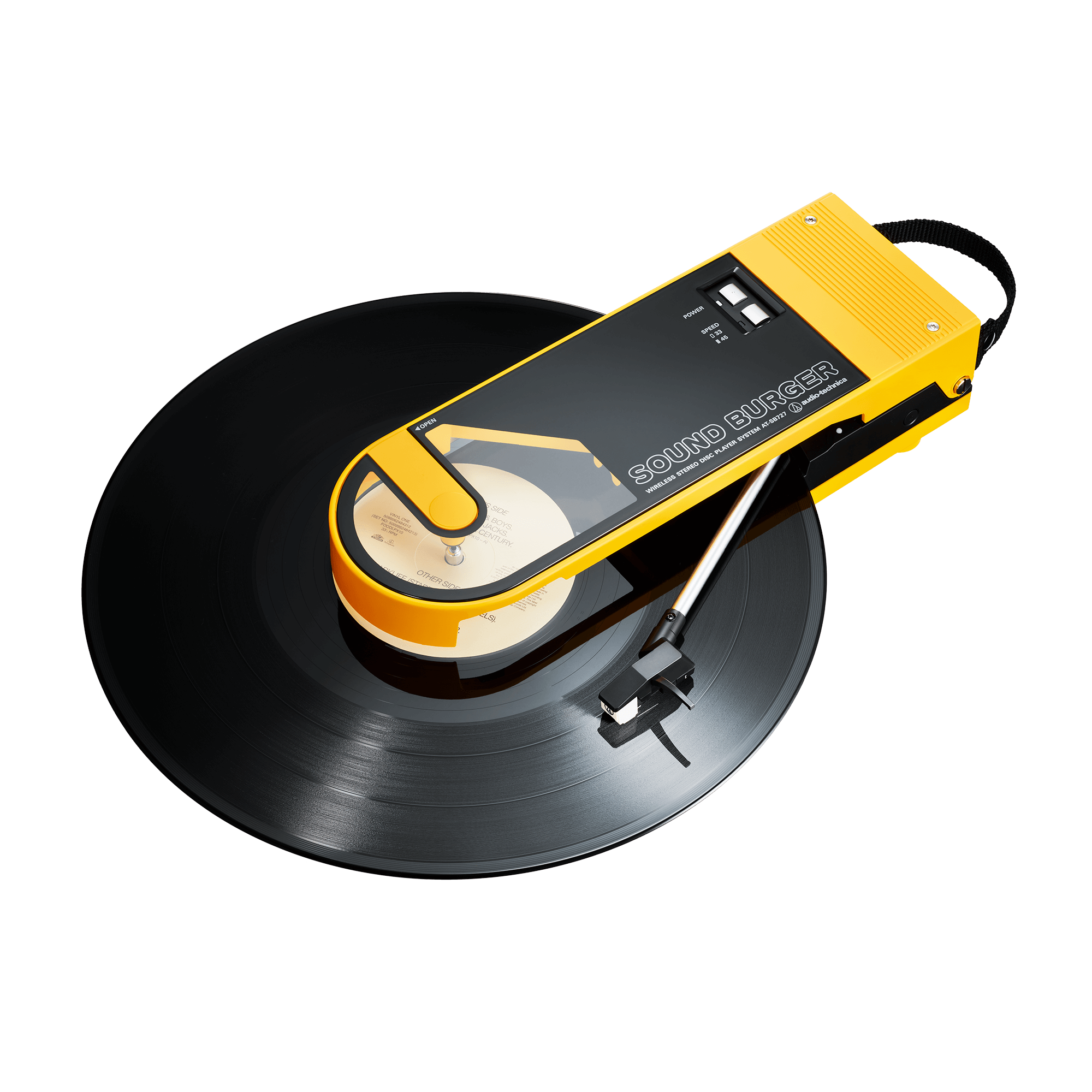
Image source: Audio Technica
- Perfect For: Vinyl lovers who want a retro-styled, Bluetooth-ready turntable they can take anywhere—even kind of vertical.
The Sound Burger is a weird one—technically a portable turntable, but its clamp-style build means it can play records in unusual positions. Vertical playback? Kind of. Just don’t flip it upside down unless you’re feeling chaotic.
It’s a modern reissue of an ‘80s classic, updated with Bluetooth, USB-C, and a tried-and-true ATN3600L stylus. While there’s no speaker on board, that’s by design—it stays light, flexible, and great for on-the-go listening.
Now, about those vertical spins: it’s fun to try, but the lack of a counterweight or anti-skate makes it less than ideal for your best vinyl. Save the rare pressings for your main rig and let the Sound Burger handle the adventures.
Fuse GLD

Image source: Fuse
- Perfect For: Beginners who want a cool-looking, Bluetooth-capable vertical setup without going all-in on audiophile gear.
The Fuse GLD is the bare-minimum pick if you want a vertical record player with some flair. It looks great, includes an Audio-Technica cartridge, and has Bluetooth output, so you can stream records wirelessly to a speaker. It even comes with external speakers that sound good for the price.
That said, this one’s more about the vibe than long-term specs. The motor noise is audible, the build feels mid-tier, and it’s not a forever turntable—but for the price, you’re getting a full setup that’s fun, stylish, and easy to use.
Pro-ject VT-E
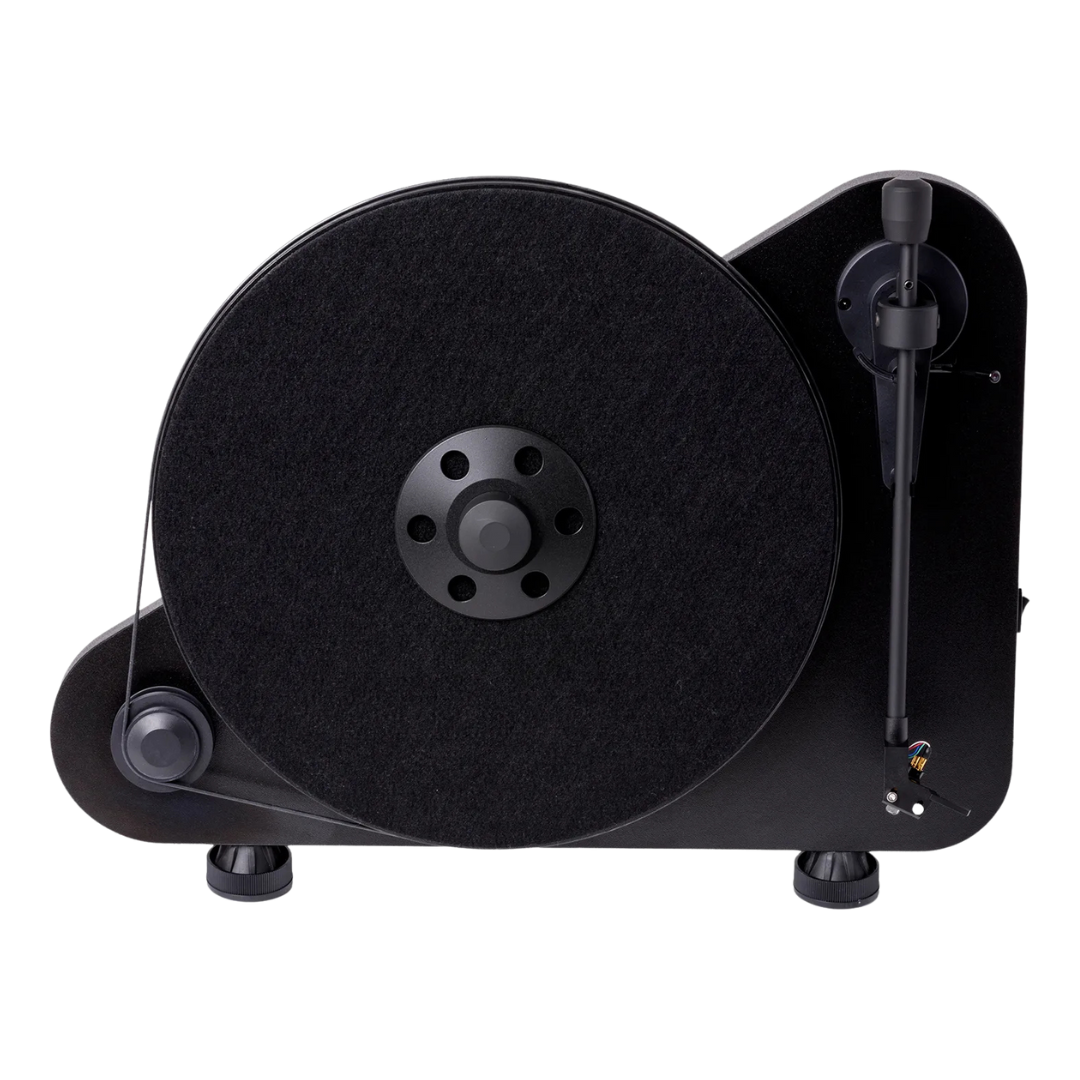
Image source: Pro-Ject
- Perfect For: Vinyl collectors looking for a display-worthy setup without sacrificing playback quality.
Alright, you want the real deal? Here it is. No messing around—second on the list, but first in quality. The Pro-Ject VT-E Vertical Plug & Play Turntable is what happens when a serious turntable company decides to make a vertical deck that actually works.
Yes, it’s expensive. Yes, it’s overkill for most casual listeners. But it’s Pro-Ject. They design and manufacture some of the best turntables in the game, and this one comes with an Ortofon OM5E cartridge, which is no joke.
What makes it special? This isn’t just a design flex. The VT-E is engineered for true vertical playback, with a belt-drive system powered by a low-vibration motor, an 8.6” aluminum tonearm, and pre-calibrated tracking force and anti-skate. Translation: it plays great right out of the box. And yes—you can mount it on the wall. If you’re after legit performance in a space-saving design, this is the one to beat.
Gramovox “Classic” Floating Record vertical turntable

Image source: Vertical Grooves
- Perfect For: Vinyl collectors who want a statement piece
If you’re looking for the king of vertical turntables, this is it. The Gramovox Floating Record is the one that started the modern hype, and it’s still the biggest flex piece in the category.
It’s got premium everything—a walnut wood base, a carbon-fiber tonearm, and built-in full-range stereo speakers. The whole “floating record” look isn’t just marketing; it actually does make your vinyl look like it’s suspended in mid-air while playing. It’s an all-in-one system, meaning no extra components are needed. Just place it, plug it in, and enjoy.
But here’s the catch—it’s $1,199. That’s a steep price for something that prioritizes form over function. You’re paying for aesthetics, and while the built-in speakers get the job done, they’re not going to compete with an external hi-fi system.
That said, if I had the money, I’d probably grab one—no judgment. Sometimes, you just want the coolest-looking thing in the room, and this definitely delivers.
| Feature | Audio-Technica Sound Burger |
Fuse Audio GLD |
Pro-Ject VT-E R (OM5e) |
Gramovox Classic Floating Record |
|---|---|---|---|---|
| Price on Amazon | $199 on Amazon | $349 on Amazon | $549 on Amazon | $1,199 at VerticalGrooves |
| Perfect For | Retro-styled, Bluetooth-ready portable listening |
Beginners who want a cool-looking, Bluetooth setup without going all-in on audiophile gear |
Display-worthy setup without sacrificing playback quality |
Collectors seeking a high-end statement piece |
| Material | Die-cast aluminum platter, alloy steel body |
Ashtree wood veneer over MDF box |
Plastic body, MDF platter |
Walnut/Maple wood base, acrylic plinth & platter |
| Drive Type | Belt-drive | Belt-drive | Belt-drive with silicone belt | Manual silicone belt-drive |
| Cartridge | VM cartridge with replaceable ATN3600LC stylus |
Audio-Technica diamond-tipped premium cartridge |
Ortofon OM5e (pre-mounted, MM stylus) |
AT95E dual-magnet cartridge |
| Record Clamping | Center spindle only | Threaded record clamp | Threaded screw-on record clamp | Threaded record clamp |
| Counterweight | None | Yes – balanced gimbal tonearm |
Yes | Yes |
| Anti-Skating | None | Not specified | Pre-set anti-skating force | Not specified |
| Wow and Flutter | < 0.25% | Not specified | 0.29% @ 33 RPM, 0.27% @ 45 RPM |
Not specified |
| External Output | 3.5 mm RCA output (adapter incl.) |
Preamp RCA line out (L/R) |
Gold-plated RCA phono output | RCA line out + phono stage + headphone amp |
| Bluetooth | Bluetooth 5.2 for wireless listening |
Bluetooth 5.3 input & output |
No | No |
Flat Might Be Boring, But It Works
Dang. After soaking in all that vertical-turntable coolness—rotating records on walls, space-age clamps, Bluetooth everything—it’s kind of a buzzkill to go back to…the plain ol’ flat kind.
But here’s the truth: the “boring” option is usually the better one.
Most people who stick with vinyl end up going this route anyway. It’s at least what we kept seeing (and building) working with vinyl enthusiasts trying to put together their first real setup (or fix the second one after the first didn’t go as planned).
For anyone who just wants a simpler, more reliable path—this is our bread and butter.
We’ve spent way more time than we’d like to admit helping people move from “cool idea” to “actually good setup,” and boy do we have something for you:
All-in-One Record Players
Keep it simple.
One box, built for small spaces and easy listening.

Get a safe, compact pick in minutes
DIY Setup Planner
Build it your way.
Compare parts and personalize your setup.

Your room, your gear, your way.
For those who really just want the easiest, simplest all-in-one thing – no shame (despite what r/turntables might say about these)—there are some decent options that give you great value in this category, and we’ve rounded them up here.
If you’re more in the “I want a real setup I can grow with” camp, that’s where our Builder comes in-pick a turntable, match the right amp and speakers, check prices and compatibility, and see the whole system before you spend a dollar.
Conclusion: Are Vertical Record Players Worth It?
We’ll give credit where it’s due—making a vertical turntable that actually works is no small feat. Some brands did it right. But a lot of the time, you’re paying for form over function. If you want a fun showpiece, cool. If you want something to build around, flat’s the better bet.
At the end of the day, vertical turntables are a choice of aesthetics over function. But if you’re here for the vibe, they can be a fun statement piece—just be ready to pay for good engineering.
Who should consider one?
- Casual Listeners – If you’re more into the look than audiophile-grade sound.
- Design Enthusiasts – A vertical record player doubles as decor and a conversation piece.
- Small-Space Dwellers – Their compact design works better (marginally) in tight spaces.
If that sounds like you, a vertical turntable might be worth it. Would I personally buy one? Probably not. But if I had the cash, I’d snag a Gramovox just for the flex—no judgment.